

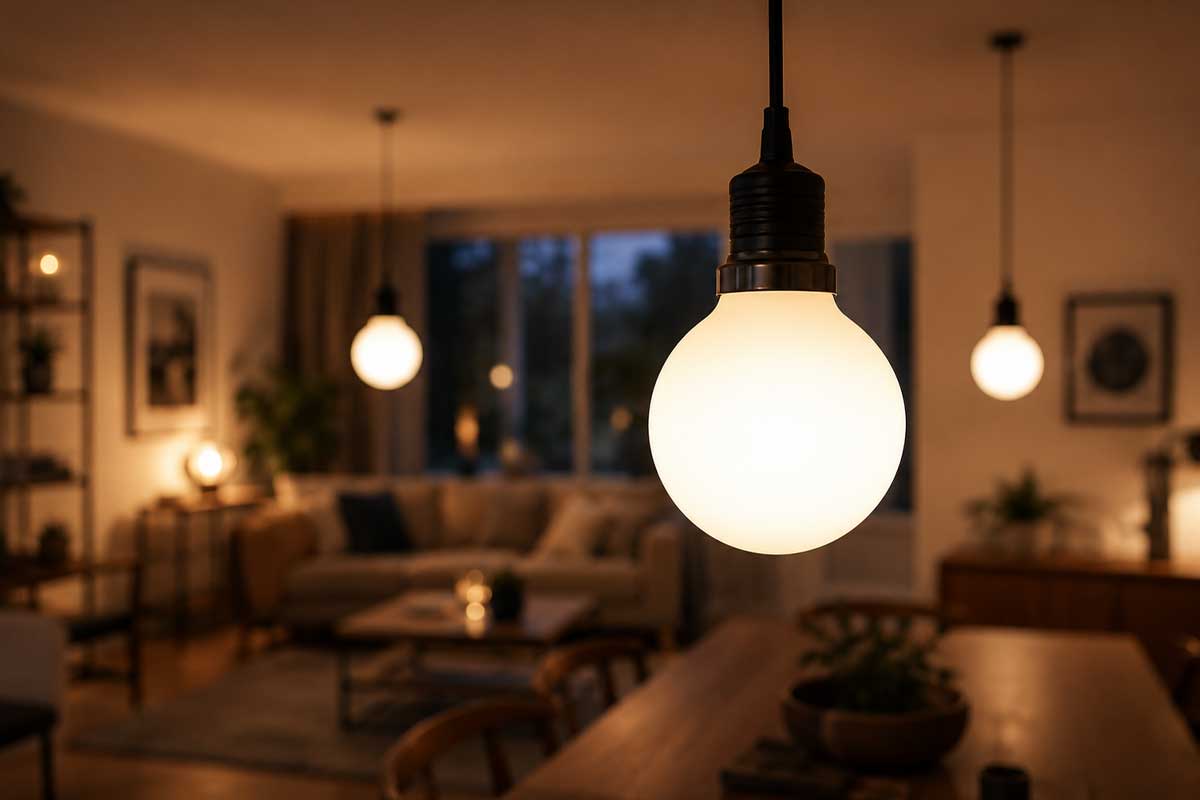
Lumens (lm) are the unit of luminous flux and indicate how much light light actually emits. The higher the number of lumens light has, the more light it can provide. Today, lumens are one of the most important factors when selecting lighting, because unlike watts, they indicate the actual light output.
Whether you’re choosing lighting for your living room, kitchen, bedroom, or bathroom, the number of lumens will help you determine if the space will have enough light for everyday use. The right amount of light not only affects comfort but also the overall atmosphere of the interior.
In this article, we’ll explain what lumens are, the difference between lumens, lux, and watts, how many lumens you need for each room, and how to choose the right lighting for your home.
Article content
- What are lumens?
- Lumens, lux, and watts: How to make sense of them?
- How many lumens do we need for each room?
- How do you calculate the required number of lumens?
- Why it’s not enough to just look at the number of lumens
- Common mistakes when choosing lighting
- FAQ: Frequently asked questions about lumens
- Lumens indicate the actual amount of light emitted by a light fixture.
- Watts indicate energy consumption, not light output.
- For a living room, 100–150 lm/m² is usually sufficient.
- Kitchens and bathrooms require approximately 200–300 lm/m².
- The required number of lumens depends on the size of the room, the ceiling height, and the placement of the light fixtures.
What are lumens?
A lumen (lm) is a unit of luminous flux that indicates the total amount of light emitted by a light source. Simply put, lumens determine how much light light actually produces. The higher the number of lumens, the more light light provides.
Why are lumens important when choosing lighting?
Lumens are among the most important parameters when choosing lighting fixtures, as they allow you to easily compare the actual light output of different technologies. Whether you’re choosing light LED light for your living room, kitchen, bedroom, or bathroom, the number of lumens will tell you whether the room will have enough light for everyday use.
The more lumens light has, the more light it emits. Lumens therefore determine brightness, while watts indicate power consumption.
With modern LED fixtures, you’ll most often find values ranging from a few hundred lumens for decorative lighting to several thousand lumens for general lighting in larger rooms. The required number of lumens always depends on the size of the space and how it’s used.

Lumens, lux, and watts: How to make sense of them?
When choosing lighting, you will most often encounter three basic parameters—lumens (lm), lux (lx), and watts (W). Although they are related, each one expresses something different. Confusing them is one of the most common reasons why the final lighting does not meet expectations.
| Parameter | What does it convey? | What is it for? |
|---|---|---|
| Lumen (lm) | Total amount of light emitted by the luminaire | Helps determine the light output lighting |
| Lux (lx) | The amount of light falling on a specific surface | Determines the level of lighting in the room |
| Watt (W) | Electricity consumption | Helps estimate operating costs |
When choosing light new light or bulb, lumens will be the most important specification for you in most cases. This is because they determine how much light the source actually produces. Watts, on the other hand, say nothing about light intensity, but only about electricity consumption.
Lux works a little differently. While lumens describe the amount of light emitted by lighting, lux expresses how much of that light actually falls on a specific surface. That is why recommended lux values are often used when designing lighting for homes, offices, or commercial spaces.
Lumens indicate how much light light produces. Luxes show how much light actually reaches the work surface. Watts only indicate electricity consumption.
In practice, when choosing lighting, most customers only encounter the lumen and wattage values listed on the packaging lighting or bulb. Lux values are primarily used by lighting designers and experts when designing specific spaces where a certain level of illuminance must be achieved.
For easier navigation, you can use the following values as a guide:
- 470 lm ≈ equivalent to a standard 40W incandescent bulb
- 800 lm ≈ equivalent to a standard 60W incandescent bulb
- 1,050 lm ≈ equivalent to a standard 75W incandescent bulb
- 1,500 lm ≈ equivalent to a standard 100W incandescent bulb
This is a clear example of why it no longer makes sense to choose lighting based on wattage. A modern LED bulb consuming just a few watts can provide the same light output as a traditional incandescent bulb with several times the power consumption.
When choosing new lighting, therefore, focus primarily on the number of lumens. Consider watts as an indication of energy consumption and lux as a guide for planning how much light you need in a specific room.
How many lumens do we need in each room?
There is no one-size-fits-all lumen requirement that works for every room. The amount of light needed depends on the size of the space, ceiling height, amount of natural light, and how the room is used. While a bedroom is primarily used for rest, a kitchen or home office requires significantly higher light intensity.
The following values are general guidelines for typical households. In practice, it is advisable to combine general lighting with additional layers of light to ensure a more even distribution of light and greater comfort in everyday use.
| Room | Recommended intensity | Example for 10 m² |
|---|---|---|
| Living Room | 100–150 lm/m² | 1,000–1,500 lm |
| Bedroom | 100–150 lm/m² | 1,000–1,500 lm |
| Kitchen | 200–300 lm/m² | 2,000–3,000 lm |
| Bathroom | 200–300 lm/m² | 2,000–3,000 lm |

How many lumens for the living room?
For a standard living room, approximately 100 to 150 lumens per square meter is most commonly recommended. A 20-square-meter room therefore typically requires a total luminous flux of approximately 2,000 to 3,000 lumens. However, more important than the output itself is the proper distribution of light through a combination of ceiling, floor, or wall lighting.
How many lumens for the bedroom?
A bedroom typically does not require as much light as a kitchen or bathroom. For general lighting, approximately 100 to 150 lumens per square meter is generally recommended. Rather than high light output, the emphasis here is on creating a pleasant atmosphere and the ability to combine general lighting with bedside lamps or indirect lighting for evening relaxation.
How many lumens for the kitchen?
The kitchen is one of the most heavily lit rooms in the home. For general lighting, a value of 200 to 300 lumens per square meter is typically recommended. In addition to lighting central lighting, it is also advisable to consider lighting for the countertop, where lighting requirements are even higher.
How many lumens for the bathroom?
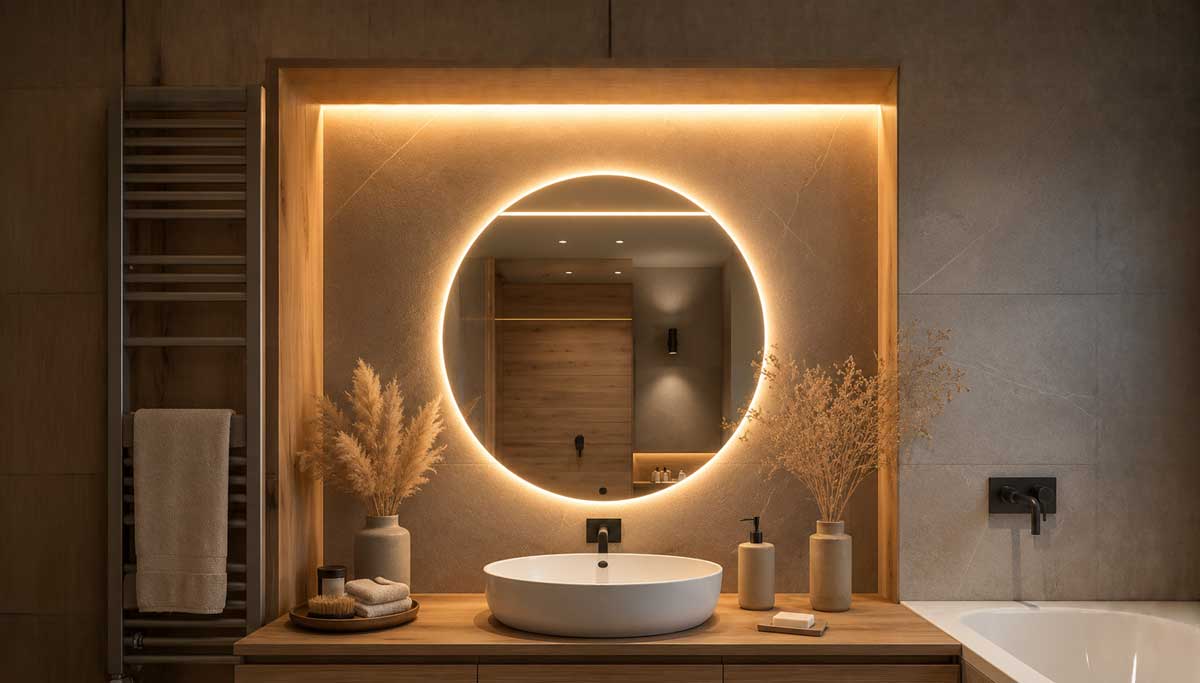
In the bathroom, approximately 200 to 300 lumens per square meter is recommended. In addition to general lighting, it is also important to have high-quality lighting around the mirror, where shaving, applying makeup, or daily hygiene routines take place. The area around the mirror often requires higher lighting intensity than the rest of the room.
How do you calculate the required number of lumens?
If you want to estimate how much light a room will need, you can use a simple calculation. All you need is the room’s area and the recommended lumens per square meter.
A 20 m² living room requires approximately 3,000 lumens at a recommended intensity of 150 lm/m².
20 m² × 150 lm/m² = 3,000 lm

Please consider this result as a rough estimate. Actual lighting requirements are also influenced by ceiling height, the amount of natural light, the color of surfaces, and the placement of light fixtures in the space.
Why isn’t it enough to just look at the number of lumens?
Lumens tell you how much light light produces, but they don’t reveal anything about how the light will actually appear in a space. Two lighting with the same luminous flux can create completely different levels of visual comfort. When selecting lighting, it is therefore not advisable to focus solely on the number of lumens, but also on other parameters that influence light quality, glare levels, or the resulting interior atmosphere.

In practice, we often find that customers choose light based solely on the number of lumens and only realize after installation that the light does not suit the character of the space.
Common mistakes when choosing lighting based on lumens
Although lumens are one of the most important parameters of lighting, misinterpreting them often leads to the resulting light not meeting expectations. In practice, we regularly encounter several recurring mistakes.
Many people underestimate the required light output and choose lighting based solely on appearance. The result is often an inadequately lit space that must later be supplemented with additional light sources.
The same number of lumens may be ideal for a small bedroom but insufficient for a spacious living room. The required light output should always correspond to the size and purpose of the room.
Even a high lumen output does not guarantee quality lighting. light single ceiling light often creates dark corners and uneven light distribution. In larger rooms, a combination of multiple light sources is usually more effective.
With modern LED lights, wattage no longer reflects actual light output. When comparing lights, it is therefore best to focus primarily on the number of lumens.
Dark walls, high ceilings, or large open spaces typically require higher light output than bright and compact interiors. Therefore, the same number of lumens may not work the same in every space.
Lumen output is a great starting point when choosing lighting, but it only delivers the best results when combined with a well-thought-out layout of the fixtures and proper design of the entire space.
Conclusion
Lumens are the most reliable way to compare the light output of fixtures and choose the right lighting for each room. By knowing the recommended lumens per square meter, you can easily determine how much light your living room, bedroom, kitchen, or bathroom needs.
However, when choosing lighting, it’s not just about the number of lumens. The resulting comfort is also influenced by the light temperature, color rendering, the placement of the fixtures, and the character of the space itself. It is precisely the combination of these factors that helps create pleasant and functional lighting for everyday life.
In our experience, the most common mistake is underestimating the amount of light needed in living spaces. Many people choose lighting primarily based on design and only realize after installation that the space doesn’t feel bright or comfortable enough.
When designing lighting, we therefore recommend considering not only the number of lumens, but also the size of the room, ceiling height, surface colors, and how the space is used. In larger rooms, a combination of multiple light sources generally yields better results than a single powerful central light.
Properly designed lighting creates a pleasant atmosphere, minimizes dark corners, and provides sufficient light for everyday activities without causing unnecessary glare.
Frequently Asked Questions About Lumens
What are lumens?
Lumen (lm) is a unit of luminous flux that indicates the amount of light emitted by a light source. The higher the number of lumens, the more light light provides.
How many lumens do I need per square meter?
It depends on the type of room. For a living room or bedroom, 100–150 lumens per square meter is usually recommended; for a kitchen and bathroom, approximately 200–300 lumens per square meter.
How many lumens are suitable for a living room?
For living rooms, 100–150 lumens per square meter is most often recommended. A 20-square-meter room therefore typically requires approximately 2,000 to 3,000 lumens.
How many lumens are suitable for a bedroom?
A bedroom typically requires approximately 100–150 lumens per square meter. A pleasant atmosphere and the ability to combine main lighting with table lamps or indirect lighting are often more important than maximum brightness.
How many lumens are suitable for a kitchen?
The kitchen is one of the rooms with higher lighting requirements. For general lighting, approximately 200–300 lumens per square meter is recommended, while the countertop may require even higher light intensity.
How many lumens are suitable for a bathroom?
For bathrooms, approximately 200–300 lumens per square meter is generally recommended. High-quality lighting for the mirror is also important, as lighting requirements there are typically higher than in the rest of the room.
Is 1,000 lumens a lot?
It depends on the size of the space. Approximately 1,000 lumens may be sufficient for a smaller bedroom, hallway, or accent lighting. For larger living spaces, this amount is usually insufficient.
How many lumens does an LED bulb have?
The most common LED bulbs offer approximately 470 to 1,500 lumens. For example, an LED bulb that replaces a standard 60W incandescent bulb provides roughly 800 lumens.
What is the difference between lumens and watts?
Lumens indicate the amount of light light light emits, while watts indicate power consumption. With modern LED fixtures, it is therefore not advisable to choose lighting based solely on wattage.
What is the difference between lumens and lux?
Lumens express the total amount of light emitted by lighting. Luxes indicate how much of this light falls on a specific surface. It is luxes that are used when designing lighting for individual rooms.
Is the number of lumens the only thing to consider when choosing lighting?
That’s not enough. In addition to luminous flux, it’s also important to consider color temperature (CCT), color rendering index (CRI), glare rating (UGR), dimmability, and proper placement of fixtures in the space.
Select lighting with the appropriate light output
The right number of lumens is one of the key factors when choosing lighting. Browse our selection of designer lighting fixtures and choose a solution that provides enough light for your home, office, and exterior spaces.
View lighting collections

Share:
Bathroom Lighting: A Blend of Functionality and Design
How to Choose Lighting for Your Dining Table