

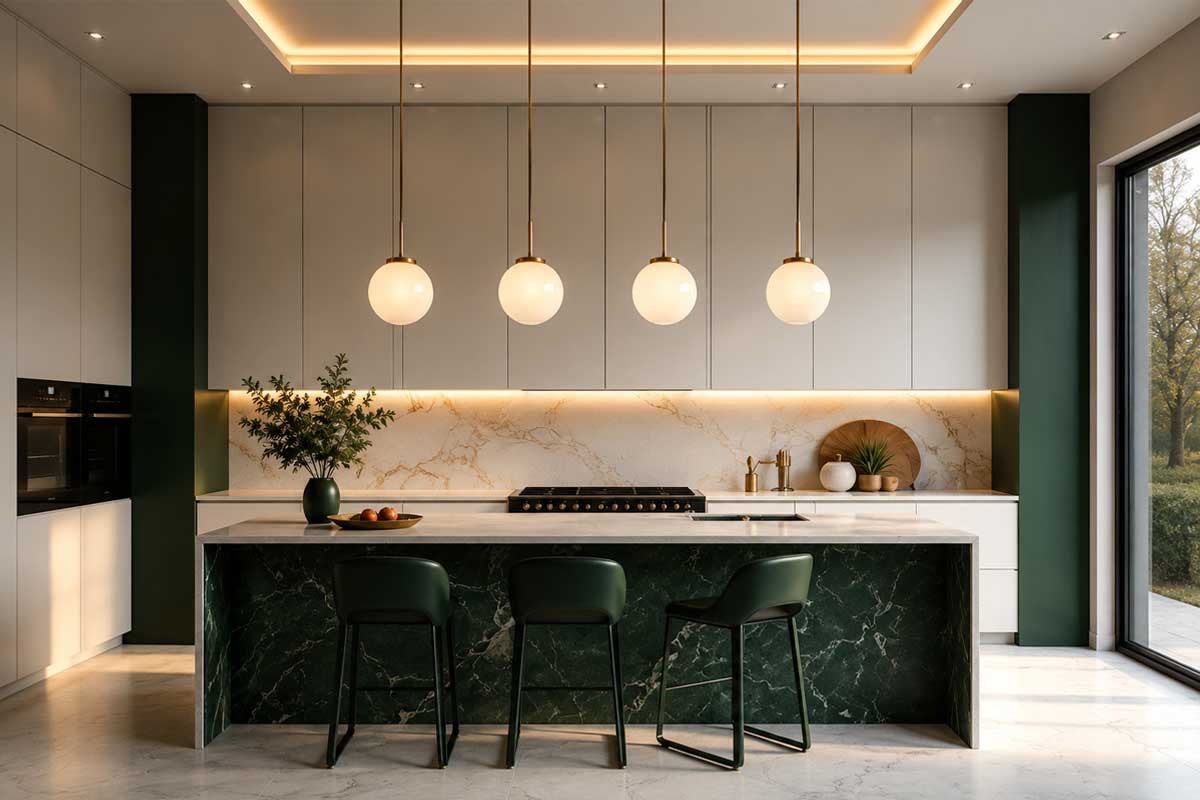
Properly designed kitchen lighting affects not only the appearance of the interior but, above all, comfort and safety during everyday use. It’s not enough to choose just one ceiling light—modern kitchens combine several layers of lighting that together ensure sufficient light for cooking, a pleasant atmosphere for dining, and practical lighting for every work area.
When planning, it’s important to consider the proper placement of light fixtures, appropriate light intensity, color temperature, color rendering index (CRI), and dimming options. Well-designed lighting can eliminate unpleasant shadows on the countertop, increase comfort while preparing meals, and at the same time highlight the design of the entire kitchen.
In this guide, you’ll learn how to properly design kitchen lighting step by step. We’ll show you what types of light fixtures to choose, where to place them, what factors to consider when selecting them, and what mistakes to avoid. Thanks to practical recommendations and real-world examples, you’ll be able to design functional and aesthetically pleasing lighting that will last for many years.
Article Content
- How to Properly Design Kitchen Lighting
- What types of lighting should every kitchen have?
- Recommended lighting layout by kitchen type
- How to Light Different Areas of the Kitchen
- What types of light fixtures are suitable for the kitchen?
- Which color temperature should you choose?
- What light output (lumens) should you choose for your kitchen?
- Common Mistakes in Kitchen Lighting
- Frequently Asked Questions
How to Properly Design Kitchen Lighting

Kitchen lighting design should be part of the overall room planning as early as the kitchen cabinet design phase. Properly placed lighting ensure sufficient light for cooking, food preparation, and dining, while also creating a pleasant atmosphere for everyday use.
You’ll achieve the best results by combining several types of lighting. Instead of a single central lighting it’s best to distribute the lighting according to the different zones of the kitchen and their intended uses.
4 Basic Steps to a Well-Lit Kitchen
Plan your lighting as early as the kitchen design phase
Plan the placement of your light fixtures at the same time you design your kitchen cabinets. This will help you avoid having to make additional changes to the electrical wiring and give you more freedom when choosing your lighting.
Identify the main lighting zones
Divide your kitchen into separate areas, such as the countertop, stovetop, sink, kitchen island, or dining table. Each area requires a different type of lighting.
Combine multiple layers of light
For best results, combine general, task, and accent lighting. Your kitchen will be well-lit while cooking and comfortable for everyday use.
Choose lighting right lighting and their placement
When making your selection, consider light intensity, color temperature, color rendering index (CRI), and proper placement to avoid shadows on your workspace.
The most common mistake is waiting until after ordering a kitchen cabinet to address lighting. If you plan the placement of your lights in advance, you’ll have more options when choosing fixtures and avoid unnecessary construction work.
What types of lighting should every kitchen have?
A modern kitchen shouldn’t rely on just one ceiling light. To ensure it’s well-lit for cooking, comfortable for dining, and cozy at the same time, it’s best to combine several layers of lighting. Each layer serves a different purpose, and together they create a balanced whole.
You can find more information about planning general, task, and decorative lighting in our article “How to Combine Different Types of Lighting in an Interior.”

General Lighting
The main purpose of central lighting is to evenly illuminate the entire room. The most commonly used options are surface-mounted ceiling lighting, spotlights, or track lighting systems, which provide sufficient light for everyday activities in the kitchen.
Work Lighting
The countertop, cooktop, and sink all require high-quality, even lighting without unwanted shadows. LED strips or linear lighting mounted under the upper cabinets are the most common solutions. For more detailed information, see our article Modern Kitchen Lighting: The Best Solutions for Above the Countertop.
Decorative lighting
Decorative lighting completes the atmosphere of the entire kitchen. It can highlight an island, open shelves, glass display cabinets, or other design elements, adding depth and coziness to the space.
None of these elements should function on its own. You’ll achieve the best results by combining them, making your kitchen both practical for cooking and pleasant for everyday use.
Recommended lighting layout by kitchen type
Every kitchen layout has its own unique characteristics. Properly chosen lighting placement helps eliminate shadows on the countertop, ensures sufficient light for cooking, and creates a pleasant atmosphere for everyday use.

| Kitchen Type | Recommended Lighting | What to Watch Out For | The perfect combination |
|---|---|---|---|
| L-shaped kitchen | light central ceiling light complemented by an LED strip under the upper cabinets. light pendant light is a good choice for above the dining table. | The countertop should be evenly lit along its entire length without any dark spots. | Surface-mounted light + LED strip + pendant light. |
| U-shaped kitchen | More light fixtures or a track lighting system complemented by high-quality task lighting. | The corners of a kitchen tend to be less well-lit, and shadows often form there. | Track system + LED strips + lighting. |
| Kitchen with an island | Central lighting complemented by pendant lights above the kitchen island and LED strips under the upper cabinets. | Place Pendant lighting at the correct height so that they do not cause glare or obstruct your view. | Pendant lighting + LED strips + surface-mounted or spot lighting. |
| Small Kitchen | One high-quality ceiling light complemented by an LED strip above the countertop. | Avoid using an excessive number of light fixtures, which can make a space look cluttered. | Surface-mounted light + LED strip. |
| Open-concept kitchen and living room | Combine general lighting with decorative lighting and dimming options to suit various situations. | It is important to match both the intensity and color temperature of the light to the adjoining living area. | Track system + pendant lighting + LED strips + dimming. |
Always adjust the placement of your lights to the actual location of your countertop, sink, stovetop, and dining table. Proper lighting placement has a greater impact on overall comfort than the number of lights alone.
How to Light Different Areas of the Kitchen
Each part of the kitchen serves a different purpose and therefore requires a different type of lighting. While the main light provides even illumination throughout the room, work areas need higher light intensity, and the dining area, on the other hand, requires a more pleasant atmosphere. By properly dividing the lighting according to individual zones, you’ll achieve greater comfort, safety, and a more attractive look for the entire kitchen.
Countertop
The work surface should be evenly lit along its entire length to prevent shadows from forming while cutting or preparing food. The best solution is to use LED strips or linear lighting mounted under the upper cabinets. The recommended illuminance is approximately 500–750 lx.
Sink
You’ll appreciate having plenty of light when washing dishes or preparing food. If the sink isn’t directly under the task lighting, it’s worth adding a separate light fixture or extending the LED strip to cover this part of the kitchen counter.
Cooktop
The area around the cooktop should be well lit without glare. In most kitchens, this function is provided by lighting built into the range hood, which should be supplemented with high-quality task lighting for the entire kitchen countertop.
Kitchen island
If the kitchen island is used for food preparation, it should have sufficient direct lighting. The most common setup involves two to three pendant lighting or light linear pendant light positioned approximately 70–90 cm above the countertop.
Dining table
It’s a good idea to create a more pleasant atmosphere above the dining table than in the kitchen’s work area. Pendant lighting with a color temperature of around 2700–3000 K are ideal, preferably with a dimming option for different situations.
Shelves and display cases
Decorative lighting for shelves or glass display cases isn’t essential, but it can make the kitchen appear more spacious and highlight its design. Hidden LED strips or small LED spotlights are most commonly used.
First, design high-quality lighting for your work areas, and only then add decorative lighting. The countertop, sink, and stovetop have the greatest impact on your everyday comfort when using the kitchen.
What types of light fixtures are suitable for the kitchen?
Modern kitchens typically don’t rely on just one light fixture. Functional and pleasant lighting is created by combining several types of lights, each of which serves a different purpose. Some provide sufficient light for working, while others create ambiance or highlight the interior design.
In most modern kitchens, it is recommended to combine at least two or three different types of light fixtures. This ensures that the space is well-lit while cooking, pleasant for dining, and visually interesting at the same time.
If you want to adapt your lighting to different situations throughout the day, we recommend choosing dimmable lighting, which allow you to easily adjust the light intensity.
| lighting Type | Where it is used | Key Benefits | Recommendations |
|---|---|---|---|
| Surface ceiling lighting | Main lighting for the entire kitchen | It provides even lighting throughout the space and is also suitable for rooms with lower ceilings. | Ideal as the foundation for any lighting design. |
| Recessed lighting | Ceilings, suspended ceilings | A minimalist look and the ability to arrange them evenly. | Particularly suitable for modern kitchens. |
| Track systems | Larger or open-concept kitchens | Flexible light direction and the option for future adjustments without the need for construction work. | A great solution for connected living spaces. |
| Pendant lighting | Above an island or dining table | They create a pleasant atmosphere while also serving as a striking design element. | Hang it approximately 70–90 cm above the tabletop or kitchen island. |
| LED strips | For under wall cabinets, on shelves, or in display cases | Uniform, glare-free task lighting with the option to create a decorative effect. | For workspaces, choose high-quality LED strips with a high CRI. |
| Wall lighting | Dining Area or Decorative Lighting | They complement the main lighting and create a cozier atmosphere. | Particularly suitable for larger kitchens or kitchens open to the living room. |
If you’re unsure about what to choose, start with high-quality general lighting and a task light above the countertop. You can always add decorative lighting later, but a lack of functional lighting is much harder to fix once the kitchen is finished.
What color temperature should you choose for your kitchen?
Color temperature determines whether the light will appear warm, neutral, or cool. In the kitchen, it has a major impact not only on the atmosphere but also on how accurately you can see the colors of food, countertops, and kitchen cabinet materials.
There is no one-size-fits-all solution. The right choice depends on whether you want to create a cozy atmosphere or the best possible conditions for preparing food.

| Light color temperature | The Nature of Light | When to choose it |
|---|---|---|
| 2700 K | Warm white | It is particularly well-suited for use above a dining table or in open-concept kitchens connected to the living room, where it helps create a pleasant atmosphere. |
| 3000 K | Warm to neutral white | The most popular choice for most kitchens. It provides pleasant lighting for everyday use while ensuring plenty of comfort while cooking. |
| 4000 K | Neutral White | Ideal for task lighting in kitchen islands or modern kitchens where optimal visibility is a priority. |
If you’re choosing just one color temperature for your entire kitchen, 3000 K is usually the most versatile option. It creates a pleasant atmosphere for dining while providing enough light for safe food preparation.
If you’re interested in how light temperature affects different rooms or what the difference is between 2700 K, 3000 K, and 4000 K, read our detailed article on the color temperature of lighting.
What light output (lumens) should you choose for your kitchen?
When choosing lighting, it’s not enough to consider only the design of the fixtures or the color temperature of the light. Their light output is just as important. If there isn’t enough light, working in the kitchen will be uncomfortable. Conversely, lighting that’s too intense can be distracting and cause unnecessary glare.
Light output is measured in lumens (lm), while the recommended illuminance for individual spaces is usually expressed in lux (lx). For standard kitchen planning, however, the approximate values listed below should suffice.
Not sure about the difference between lumens, lux, and watts? We explain everything in detail in the article “What Are Lumens and How Many Do We Need?”
Recommended lighting levels by zone
| Kitchen section | Recommended intensity | Reason |
|---|---|---|
| The entire kitchen | 300–500 lx | Uniform lighting for general movement and everyday use. |
| Countertop | 500–750 lx | Safe cutting, cooking, and food preparation without shadows. |
| Sink | 300–500 lx | Plenty of light for washing dishes and handling food. |
| Dining table | 200–300 lx | A pleasant dining atmosphere without unpleasant glare. |
| Kitchen island | 300–500 lx | It depends on whether it is used only for food preparation or also for dining. |
Approximate light output based on kitchen size
| Kitchen Size | Total Recommended Light Output |
|---|---|
| Up to 8 m² | 2,500–4,000 lm |
| 8–12 m² | 4,000–6,000 lm |
| 12–18 m² | 6,000–8,000 lm |
| Over 18 m² | 8,000 lm and above |
Please consider the values listed here as approximate. The actual required light output is influenced by ceiling height, wall color, the amount of natural light, and the number of other light sources, such as LED strips, pendant lights, or spotlights.
If you’re unsure, it’s best to design your kitchen with a slight margin of light output and choose dimmable lighting. You can then easily adjust the light intensity for cooking, cleaning, or evening relaxation.
Why Color Rendering Index (CRI) Is Important in the Kitchen
While lumens determine how much light light emits, the color rendering index (CRI) indicates how accurately the light renders the true colors of illuminated objects. The higher the CRI value, the more natural food, countertops, and kitchen cabinet materials will appear.
In the kitchen, high-quality color rendering is more important than many people realize. When preparing food, it helps you better assess the freshness of meat, fruit, or vegetables and makes cooking easier. At the same time, a higher CRI highlights the natural grain of wood, stone, and other materials used in the interior.

| CRI value | How it renders colors | Recommendations |
|---|---|---|
| CRI 80 | Adequate color rendering for everyday use. | More suitable for technical areas or spaces that are used less frequently. |
| CRI 90+ | Very accurate and natural color rendering. | ✅ The recommended choice for most modern kitchens. |
| CRI 95+ | Superior color rendering that is almost indistinguishable from natural daylight. | Ideal for discerning users, design projects, or professional kitchens. |
When choosing kitchen lighting, we recommend selecting lighting with a CRI of at least 90. The difference compared to the standard CRI of 80 is clearly noticeable in everyday use—food colors appear more natural, the work surface is easier to see, and the entire interior takes on a more vibrant and high-quality look.
If you're wondering why the color rendering index has such a big impact on the appearance of food and interiors, read our detailed article "What Is CRI and How Does It Affect the Appearance of Colors in Interiors?"
How to calculate how many lights your kitchen will need
The number of light fixtures depends primarily on the size of the kitchen, the light output of each fixture, and their placement. The goal is not to use as many lights as possible, but to evenly illuminate the entire space without dark spots or glare.
| Kitchen Size | Approximate number of main light sources | Recommended Solution |
|---|---|---|
| Up to 8 m² | 1 surface-mounted light or 2–4 spotlights | Complement your main lighting with an LED strip above the countertop. |
| 8–12 m² | 1–2 lighting or 4–6 spotlights | A combination of general and task lighting is recommended. |
| 12–18 m² | 2 larger lighting or 6–8 spotlights | Add light pendant light above your dining table or kitchen island. |
| Over 18 m² | Custom designs based on your layout | Track systems or multiple independently controlled lighting circuits are most commonly used. |
Common Mistakes in Kitchen Lighting

❌ Only one ceiling light
A single overhead light is usually not enough. When you’re working, you often cast a shadow with your own body, leaving your workspace inadequately lit.
❌ Missing countertop lighting
Without high-quality lighting in the workspace, shadows form that reduce both comfort and safety while cooking. LED strips or linear lighting under the upper cabinets are the ideal solution.
❌ Inappropriate light temperature
Light that is too cool or, conversely, too warm can negatively affect the look of the entire kitchen. In most households, 3000 K has proven to be the best compromise.
❌ Low CRI
Lighting with a low color rendering index distort the appearance of food and materials. For the kitchen, we recommend choosing lighting with a CRI of at least 90.
❌ Poorly placed lighting
Lighting should be tailored to work areas, not just the center of the room. Proper placement is more important than the number of light fixtures.
❌ Forgotten dimming
You’ll appreciate the ability to adjust the light intensity while cooking, cleaning, or relaxing in the evening. If your budget allows, it’s worth factoring in dimming capabilities right from the design phase.
If you’re planning the lighting for your entire interior, we recommend reading our article “The Most Common Mistakes in Interior Lighting and How to Avoid Them,” where we discuss lighting design mistakes in more detail.
Conclusion
Well-designed kitchen lighting significantly affects comfort while cooking, safety, and the overall atmosphere of the interior. The foundation lies in a combination of general, task, and accent lighting, properly selected light intensity, an appropriate color temperature, and high-quality light sources with a high color rendering index (CRI).
When planning, it’s a good idea to consider the placement of light fixtures as early as the kitchen design phase. This will help you avoid unpleasant shadows on the countertop, ensure evenly lit spaces, and create a kitchen that’s not only practical for everyday cooking but also pleasant for dining together and spending time with your family.
If you’re unsure about which fixtures to choose or how to arrange them properly, draw inspiration from the recommendations in this article and select lighting based on the specific layout of your kitchen. Well-designed lighting will serve you reliably for many years.
Frequently Asked Questions (FAQ)
What kind of lighting is best for the kitchen?
For the best results, combine general ceiling lighting with task lighting above the kitchen countertop and, if desired, decorative fixtures above the dining table or kitchen island. With multiple layers of light, your kitchen will be both practical and pleasant for everyday use.
What color temperature is best for a kitchen?
For most homes, we recommend a color temperature of 3000 K, which offers the ideal balance between a cozy atmosphere and high-quality lighting for cooking. You can also use 4000 K over the countertop if you prefer a brighter, more neutral light. Learn more about the differences in the article “How to Choose the Right Color Temperature.”
How many lumens do I need for my kitchen?
It depends on the size of the room and the number of light sources. As a general guideline, a total light output of approximately 2,500 to 8,000 lumens is recommended, and the countertop should be illuminated more brightly than other parts of the kitchen.
What CRI should kitchen lighting have?
For the kitchen, we recommend choosing lighting with a CRI of at least 90. This will make the colors of food, countertops, and other materials appear more natural and true to life. For more information, see the article “What Is CRI and How Does It Affect Color Appearance?”
Are LED strips suitable for use as the main lighting in a kitchen?
No. LED strips are primarily used for task lighting or decorative lighting. Main lighting should be provided by light ceiling light, spotlights, or a track lighting system.
How high should you hang a light above the dining table or kitchen island?
In most cases, it is recommended to position the bottom edge of lighting pendant lighting approximately 70 to 90 cm above the tabletop or kitchen island. The exact height depends on the size lighting and the ceiling height.
What IP rating do kitchen lighting need?
IP20 is sufficient for a standard kitchen. If light is located near a sink or another area with high humidity, a higher protection rating may be appropriate depending on the specific installation.
Are lighting better than surface-mounted light?
It’s hard to say that one solution is always better. lighting allow for more precise light direction, while surface-mounted lighting provide even lighting throughout the entire room. Often, both options are combined.
Is dimmable lighting worth it for the kitchen?
Yes. Dimming allows you to adjust the light intensity to suit different situations—from bright lighting while cooking to a cozy atmosphere during dinner or when spending time with family.
What is the best light for a kitchen island?
The most common approach is to use one or more pendant lights, which evenly illuminate the work surface while also serving as a striking design element for the entire kitchen.
Can you plan your own kitchen lighting?
Yes, as long as you follow the basic rules—divide the kitchen into separate lighting zones, choose the right light output and color temperature, and select high-quality lighting with a high CRI. For larger or non-standard kitchens, however, it’s worth consulting an expert.
Choose lighting suitable for the kitchen
Properly designed lighting makes cooking easier, enhances the dining experience, and accentuates the look of your entire kitchen. Browse our selection of ceiling lights, pendant lights, spotlights, and LED strips, and choose a solution that perfectly matches your space and interior style.
Browse kitchen lighting
Share:
3f track systems: A Complete Guide to Selection, Wiring, and Use
Integrated LED Module vs. Incandescent Bulb – Pros, Cons, and Comparison