

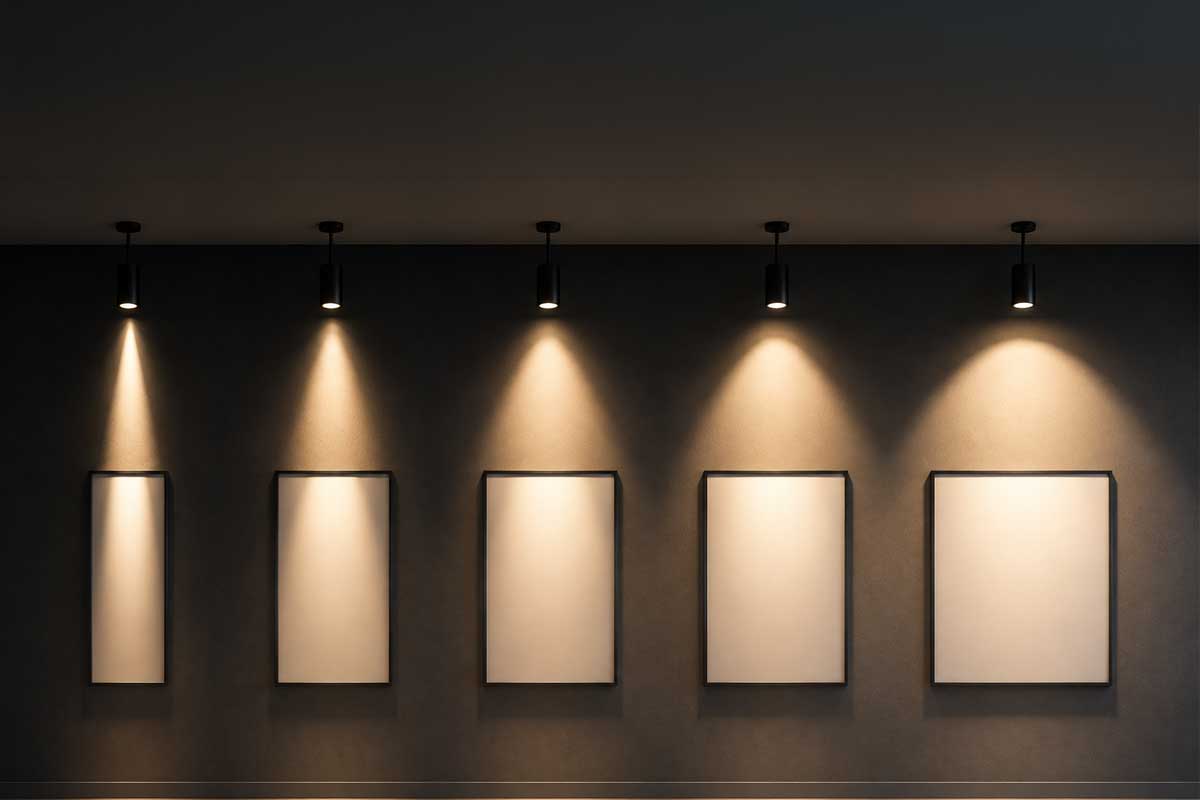
The beam angle is one of the most important parameters when choosing LED lighting, yet many people do not pay enough attention to it. It is precisely this parameter that determines whether the light will illuminate only a specific object or evenly cover the entire room. Even two lighting with the same light output can have completely different effects due to their different beam angles.
The right beam angle affects not only the look of your interior but also your comfort in everyday use. While a narrow beam is ideal for highlighting artwork or decorative items, a wider beam is better suited for general lighting using ceiling fixtures in the living room, kitchen, or office. If you’re not sure how much light you actually need, we recommend reading the article “What Are Lumens and How Many Do We Need?” first.
In this guide, we’ll explain step by step what a beam angle is, how it affects light intensity and distribution, which angle to choose for different rooms, and what mistakes to avoid when making your selection. With practical examples and clear illustrations, you’ll easily be able to choose lighting that meets your needs.
Article Content
What is the beam angle?
The beam angle indicates how widely the light from lighting or LED bulb is dispersed into the space. It is expressed in degrees (°) and determines how large an area the light illuminates at a given distance from the source.
The narrower the beam angle, the more the light is concentrated on a smaller area. This results in more intense lighting of a specific spot, such as a painting, a countertop, or a decorative item. Conversely, a wide beam angle spreads the same amount of light over a larger area, so the lighting appears more even and is better suited for general room lighting.
🎯 Narrow beam angle
15–24°
A concentrated beam of light suitable for highlighting paintings, decorations, display cases, or architectural features.
💡 Medium beam angle
36–60°
The most versatile solution for most spotlights in homes. It offers a good balance between light intensity and coverage.
🌞 Wide angle
90–120°
It provides even lighting over a large area. Ideal for general lighting in rooms, offices, or LED panels.

💡 Good to know
The beam angle does not determine how much light light produces, but rather how the light is distributed throughout the space. Two lighting with the same luminous flux can appear completely different depending on their beam angles.
How does the beam angle work?
Imagine light as a cone emanating from lighting. The narrower the cone, the more light is concentrated on a smaller area. Conversely, a wider cone spreads the same amount of light over a larger area, resulting in more even but less intense lighting.
This means that two LED lighting with the same luminous flux can produce completely different effects. A fixture with a 15° beam angle creates a striking accent of light, while light same light with a 90° beam angle illuminates a significantly larger portion of the room.

How to Choose the Right Beam Angle in 4 Steps
- Determine the purpose of the lighting—do you want to highlight a specific object, or evenly illuminate the entire room?
- Take the ceiling height into account—the higher light is placed, the larger an area the light beam will cover.
- Choose the right beam angle—narrow angles (15–24°) are suitable for accent lighting, while wider angles (60–120°) are suitable for general lighting.
- Combine the beam angle with the light output—you’ll achieve the right result only with the right combination of lumens and beam angle.
💡 Expert Tip: There is no single “best” beam angle. The right choice always depends on what you want to illuminate, how high light is mounted, and what lighting effect you’re looking for.
What beam angle should you choose?
There is no single universal beam angle suitable for all situations. It depends on whether you want to highlight a specific object, create a pleasant atmosphere, or evenly illuminate the entire room. Below you will find an overview of the most common beam angles and their typical uses.
As a general rule, the smaller the beam angle, the more concentrated and intense the light beam. Conversely, a larger beam angle spreads the light over a larger area and ensures more even illumination of the space.

💡 Good to Know: The same luminous flux (lumens) will appear much more intense at a 15° angle than at a 90° angle, because the light is concentrated on a significantly smaller area.
15° – very narrow beam angle
A 15° beam angle creates a highly concentrated beam of light. It is primarily used where you want to draw attention to a specific object or architectural detail. Thanks to its high light intensity, it can create a striking contrast between the illuminated area and the surrounding space.
Paintings, sculptures, display cases, decorations, or exhibition spaces.
Very intense lighting of a precisely selected area.
It is too narrow for general room lighting and creates stark light contrasts.
Galleries, showrooms, luxury interiors, or highlighting decorative elements.
24° – accent lighting
A 24° beam angle is still relatively narrow, but it offers slightly wider coverage than 15°. It is often used in modern interiors to illuminate shelves, kitchen cabinets, or individual design elements.
Decorative items, shelves, work surfaces, or small niches.
It combines high light intensity with slightly wider coverage.
Larger rooms may require more light fixtures.
Kitchens, hallways, commercial spaces, or designer interiors.
36° – the most versatile choice for most interiors
A 36° beam angle is one of the most commonly used options for LED spotlights. It offers an ideal balance between light intensity and the size of the illuminated area. This makes it suitable for both ordinary households and offices, hotels, or commercial spaces.
When fixtures are properly positioned, they create pleasant and even lighting without any noticeable dark spots. That is why 36° is often the recommended choice for most new installations.
Living rooms, kitchens, hallways, bathrooms, and offices.
A balanced ratio between light intensity and coverage of the space.
For very high ceilings, a wider beam angle may be more suitable.
Recessed lighting, ceiling lights, and kitchen cabinet lighting.
60° – wide and pleasant lighting
The 60° beam angle creates a wide light cone that evenly illuminates most of the room. It is often used in spaces where the goal is to create a pleasant atmosphere without stark light contrasts.
Compared to a 36° beam angle, it covers a larger area, but the light won’t be as intense. This makes it suitable, for example, for general lighting in smaller rooms or in areas where you want to minimize the number of light fixtures.
Living rooms, bedrooms, dining rooms, or small offices.
More even light distribution over a larger area.
It isn't bright enough to highlight paintings or decorations.
Main lighting for living spaces or larger ceiling lighting.
90–120° – maximally even lighting
Wide beam angles ranging from 90° to 120° distribute light throughout nearly the entire room. They are most commonly used in LED panels, ceiling fixtures, or linear lighting, where the goal is to achieve the most uniform lighting possible without significant shadows.
This type of lighting is not intended to highlight specific objects, but rather to create a comfortable lighting environment throughout the entire space.
Offices, classrooms, kitchens, utility rooms, or LED panels.
Very even lighting over a large area.
This light is not suitable for accent or decorative lighting.
Office buildings, schools, hospitals, or modern homes with general lighting.
How the Beam Angle Affects the Placement of Light Fixtures
The beam angle affects not only the shape of the light cone but also how far apart individual lighting can be spaced. If you use a beam angle that is too narrow, dark spots will appear between the light cones. Conversely, a beam angle that is too wide can cause unnecessary light overlap and lower contrast.
When designing lighting, it is therefore always necessary to consider not only the beam angle itself, but also the ceiling height, the distance between fixtures, and the purpose of the lighting. The right combination of these parameters ensures even lighting without unwanted shadows.

What factors determine proper placement?
The higher light is placed, the larger the area the light beam will cover.
A wider angle means greater coverage of the space, while a narrower angle means higher light intensity.
A higher lumen output will help illuminate a larger area, but it cannot replace a properly selected beam angle.
Different spacing patterns are suitable for general lighting, while others are ideal for highlighting artwork, shelves, or workspaces.
For standard recessed ceiling lights with a beam angle of around 36°, spacing of approximately 1 to 1.5 meters is most commonly recommended. However, the exact distance always depends on the ceiling height and the desired lighting intensity.
💡 Expert Tip: When designing a new lighting scheme, don’t consider individual lighting in isolation. It’s important that their light cones complement each other naturally to create a uniformly lit space without any noticeable dark spots.
Recommended beam angle by room
The ideal beam angle varies depending on the type of room and the purpose of the lighting. While the goal in a living room is to create an evenly lit space without sharp transitions, in a kitchen or above a countertop, it may be more appropriate to focus the light more. That’s why it’s a good idea to adjust the beam angle to your specific needs.
In practice, angles between 36° and 60° are most commonly used, as they offer a versatile solution for most homes. Narrower angles are primarily used for accent lighting or to highlight decorations.
| Room | Recommended beam angle | Note |
|---|---|---|
| Living Room | 36–60° | Even lighting without noticeable shadows. |
| Kitchens | 36–60° | The wider beam makes it easier to illuminate the work area. |
| Bedroom | 36–60° | Pleasant, diffused light for relaxation. |
| Bathroom | 36–60° | It is important to ensure even lighting of both the mirror and the surrounding space. |
| Hallway | 60° and above | The wide angle helps eliminate dark spots. |
| Artwork and Decorations | 15–24° | A narrow beam highlights a specific object. |
Common Mistakes When Choosing a Beam Angle
The beam angle is often an overlooked parameter when selecting lighting. Yet choosing the wrong beam angle can result in dark spots, uneven lighting, or, conversely, an unnecessarily overlit space. The good news is that most of these mistakes can be easily avoided.
The narrow beam angle creates distinct transitions between light and shadow. If you use it as the main lighting for a room, dark spots will form and the space will not appear evenly lit.
A wide beam angle spreads the light over a large area, causing the highlighted object to lose its impact. As a result, paintings, decorations, or architectural details will not stand out as they should.
The same beam angle will behave differently in a room with a 2.5-meter-high ceiling than in a 4-meter-high space. The higher light is mounted, the larger an area the light cone will cover.
Many people choose lighting based solely on appearance and don’t consider the technical specifications until later. The result can be lighting that looks good but doesn’t serve its purpose.
You’ll achieve the best results when you select the beam angle in conjunction with the light output, color temperature, and lighting fixture placement. These parameters influence one another and together determine the resulting lighting quality.
Conclusion
The beam angle is one of the most important parameters affecting both the appearance and functionality of lighting. It determines whether the light will be focused on a specific object or spread evenly throughout the room. A properly selected beam angle helps create a pleasant atmosphere, improves visual comfort, and allows for the efficient use of lighting lighting light output.
For most living spaces, lighting with a beam angle of around 36° to 60° are most commonly used, as they offer a good balance between light intensity and coverage area. Narrower beam angles are primarily used to highlight paintings, decorations, or architectural features, while wider beam angles are suitable for general lighting in larger rooms.
If you’re planning new lighting, we recommend considering not only the beam angle, but also the luminous flux (lumens), light color (CCT), color rendering index (CRI), and the right LED bulbs. Only by combining these factors can you ensure lighting that not only looks good but is also comfortable for everyday use.
Frequently Asked Questions (FAQ)
What is the beam angle?
The beam angle indicates how widely light is emitted from lighting or LED bulb. A smaller angle creates a narrow, intense beam of light, while a larger angle illuminates a wider area with more even light.
What is the best beam angle for a home?
For most living spaces, a beam angle between 36° and 60° is most commonly recommended. It offers a good balance between light intensity and the size of the illuminated area.
What beam angle should you choose for lighting?
Recessed spotlights most commonly use a beam angle of around 36°. This is suitable for general lighting in living rooms, kitchens, bedrooms, and hallways.
When should you choose a narrow beam angle?
An angle of 15–24° is ideal for highlighting paintings, decorations, display cases, or architectural features. It concentrates the light onto a smaller area and creates a striking lighting effect.
Is a wider beam angle always better?
No. A wider angle illuminates a larger space better, but the light will be less concentrated. A narrower beam angle is usually better suited for accent lighting.
How are the beam angle and the number of lumens related?
Lumens determine the total amount of light, while the beam angle determines its distribution. The same luminous flux can appear significantly more intense at a narrower angle than at a wide angle.
How does the beam angle affect the placement of spotlights?
The narrower the beam angle, the closer lighting should be placed to each other to avoid dark spots between them. Wider beam angles allow for greater spacing.
Does ceiling height affect the beam angle?
Yes. S the ceiling height increases, the light cone widens and covers a larger area. Therefore, when designing lighting, it is necessary to consider not only the beam angle but also the installation height.
What beam angle is best for a kitchen?
For general kitchen lighting, an angle of 36–60° is most often recommended, as it ensures even lighting of both the work surface and the entire room.
Can the beam angle of an LED lighting be adjusted?
For most standard LED fixtures, the beam angle is fixed by the manufacturer. However, some professional spotlights or optical systems allow for lens replacement or the adjustment of different angles.
Choose lighting with the ideal beam angle
Our selection includes spotlights and ceiling lighting with various beam angles for both general and accent lighting. Choose the solution that best suits your interior.

Share:
How to Choose an LED Bulb?
How to Choose Designer Lighting for Your Interior