

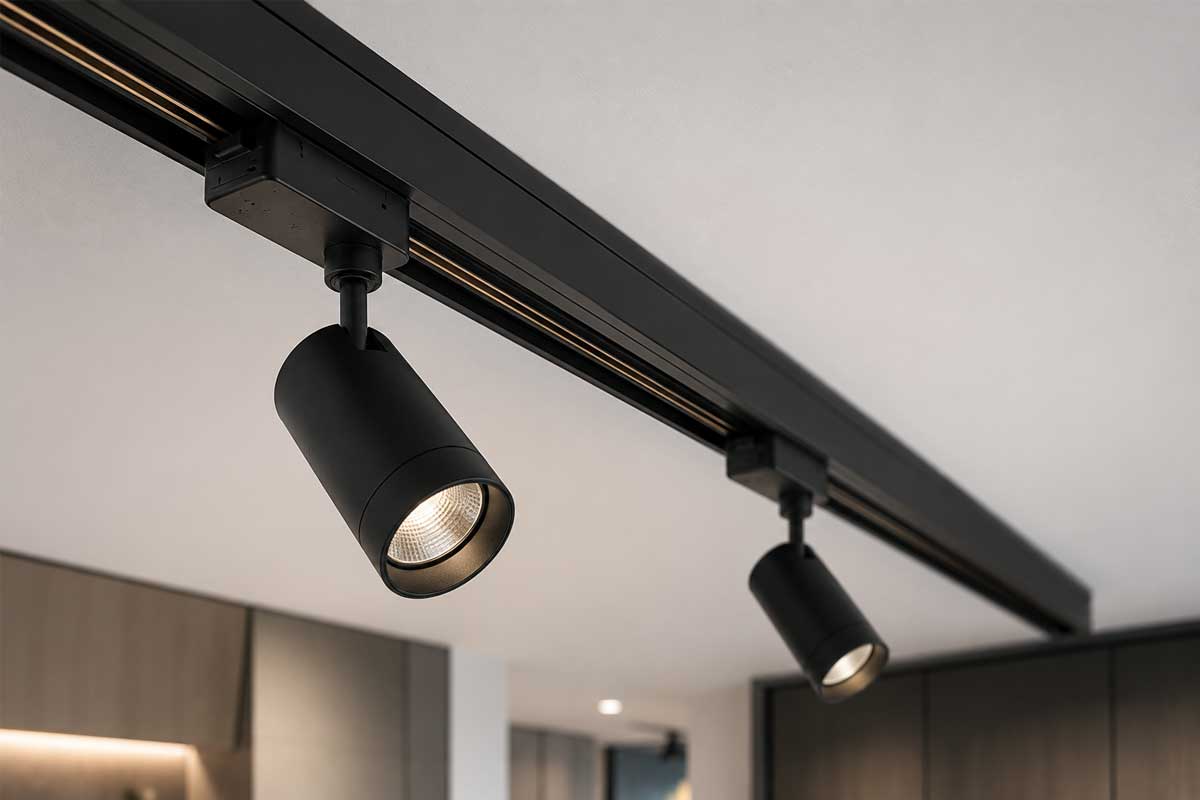
The 3f track system consists of several interconnected components that together provide power, facilitate installation, and allow for flexible lighting expansion. Thanks to its modular design, individual parts can be easily combined, added to, or modified to suit the needs of a specific space.
In this comprehensive guide, you’ll find answers to all your important questions. We’ll explain how three-phase track work, introduce the individual components, offer advice on designing and selecting the right fixtures, and highlight the most common mistakes to avoid during installation. Whether you’re furnishing a store, an office, or a modern home, you’ll gain the insight you need to easily choose the right system for your needs.

What You'll Learn in This Article
- ✔ What is the 3f track system, and how do the three independent lighting circuits work?
- ✔ Where are three-phase tracks most commonly used, and why are they the standard in commercial lighting?
- ✔ How to choose the right track, spotlights, connectors, and other accessories.
- ✔ How to design, wire, and, if necessary, expand a 3-phase track system.
- ✔ What is the difference between 3f and magnetic 48V tracks, and which system is better suited for your project?
Article Content
- What is the 3f track system?
- How a three-phase power strip works
- What does the 3f track system consist of?
- Types of 3f track and their uses
- What types of lighting can be used with 3-phase track
- How to Design and Wire a 3-Phase Track System
- 3f or 48V—which system should you choose?
- Common Mistakes in Design and Installation
- Frequently Asked Questions (FAQ)
What is the 3f track system?
The 3f track system (three-phase track system) is a professional method for powering and mounting lighting fixtures, allowing for the operation of several independently controlled lighting groups on a single shared track. It is most commonly used with spotlights, linear fixtures, or pendant lights in stores, galleries, offices, restaurants, and modern homes.
The designation “3f” does not mean that the system must be connected to a three-phase electrical connection. The name is based on the design tracks tracks itself, which contains three separate power circuits. Thanks to these circuits, individual lighting can be divided into several groups and each group can be controlled independently, without the need to install multiple separate track.
Another major advantage is its high flexibility. Lighting can be easily moved along the track, added, or replaced according to the current needs of the space. For example, if you rearrange shelves, display items, or office desks, there’s no need to modify the electrical wiring—simply adjust the position of the spotlights or add additional lighting.
When choosing spotlights, it’s not enough to consider only their wattage. Equally important are luminous flux (lumens), color rendering index (CRI), the correct color temperature (CCT), and an appropriate beam angle, all of which have a significant impact on the final quality of the lighting.
Who is the 3f track system ideal for?
3f track systems are particularly valuable in situations where high-quality, flexible lighting is needed, with the ability to control multiple groups of fixtures independently. Thanks to its modular design, the system can be easily expanded, the placement of fixtures can be adjusted, or the lighting can be adapted to a new use of the space.
- Stores and showrooms—lighting for storefronts, shelves, or displayed products.
- Galleries and museums—precise lighting direction for paintings, sculptures, and exhibits.
- Offices – a combination of general and accent lighting for work areas.
- Hotels, restaurants, and cafes—the ability to create different lighting scenes based on the time of day.
- Modern single-family homes—open floor plans, kitchens with living rooms, or home offices.
How a three-phase power strip works
At first glance, the 3f track system looks just like a standard lighting track. But the real difference lies inside. The three-phase track contains several separate conductors, allowing lighting to be divided into three independently controlled groups. All lighting are mounted on a single shared track.
Inside tracks are three phase conductors (L1, L2, and L3), a common neutral conductor (N), and a protective conductor (PE). During installation, each light is assigned to a specific circuit from which it will be powered. This allows individual groups of lights to be controlled separately without the need to install multiple separate track.
In practice, for example, the first circuit could be designated for lighting the storefront window, the second for the shelves, and the third for the checkout area. In a modern single-family home, the lighting for the kitchen, dining table, and living area can be separated in the same way. Each group can be turned on independently as needed.
Thanks to this design, the 3f track system offers a high degree of flexibility. If the interior layout changes or you need to add another spotlight, simply move light or add light to the track. There’s no need to tear down ceilings or tamper with the electrical wiring, which makes future lighting adjustments much easier. If you’re looking for a solution geared more toward the minimalist design of modern interiors, we also recommend our guide to magnetic 48V track systems.

| Label | Meaning |
|---|---|
| L1 | The first independent lighting circuit. |
| L2 | Second independent lighting circuit. |
| L3 | Third independent lighting circuit. |
| N | Common neutral wire. |
| PE | A protective conductor that ensures the safe operation of the system. |
Important: The “3f” designation does not mean that every installation must be connected to a three-phase electrical supply. The name refers to the design tracks and the option to use three separate power circuits. The specific wiring method always depends on the electrical installation design and the requirements of the given project.
How do you choose the right socket for light?
Each light designed for the 3-phase track system is equipped with a special adapter that allows you to choose which power circuit it will be connected to. During installation, simply set the switch to L1, L2, or L3, and light will become part of the selected lighting group.
With this solution, two identical spotlights can be placed side by side, yet each responds to a different switch or control system. This eliminates the need to install multiple separate track or run additional wiring. The individual lights are divided into circuits either during installation or when the system is modified later.
If the use of the space changes in the future, most of the fixtures can be easily moved to another location on the track or reassigned to a different circuit. It is precisely this flexibility that is one of the main reasons why three-phase track systems are popular in stores, galleries, offices, and modern interiors.
What does the 3f track system consist of?
For the 3f track system to be fully functional, the track and spotlights alone are not enough. The entire system consists of several mutually compatible components that provide power, connect the individual parts, and allow for future expansion. The advantage of the modular design is that the system can be gradually expanded or modified to meet the changing needs of the interior.
Although individual components may differ in shape or construction depending on the manufacturer, their operating principle remains the same. Below is an overview of the most important parts you’ll encounter when designing or purchasing a 3f track system.

3f strip
The 3f rail forms the foundation of the entire system. It serves as a support structure for all connected lighting and also contains wiring to power three independent lighting circuits. It is manufactured in various lengths and, using connectors, can be easily extended or joined to form larger configurations depending on the layout of the space.
Spotlights and other lighting
LED spotlights, linear fixtures, and pendant lighting can be installed on 3f track. Thanks to special adapters, they can be moved along the entire length tracks at any time or reassigned to different lighting circuits without the need for additional construction work.
Power cord
Every 3f track system requires a power supply that delivers electrical power to tracks. Depending on the design, it can be placed at the beginning, in the middle, or at the end of the assembly to best suit the layout of the space and the installation method.
Connectors and End Caps
Using connecting elements, you can create straight, corner, and complex configurations. Straight connectors as well as L, T-, and X-shaped variants are available. End caps then close off the open ends track and protect their interior from damage.
Suspension system
If direct ceiling mounting is not suitable, tracks can be suspended using steel cables. This installation method is used primarily in high-ceilinged rooms, offices, galleries, or retail spaces, where it allows the light to be positioned closer to the illuminated area.
Types of 3f track and their uses
3f track systems are available in several design variants, which differ primarily in their mounting method and final appearance. All operate on the same principle and offer the same options for controlling individual lighting circuits. The main difference lies in how the track fits into the interior and how complex its installation is.

Surface 3-phase track
Surface-mounted 3-phase tracks are installed directly on the ceiling or wall and do not require complex construction work. Thanks to their simple installation, they are suitable for both new construction and renovations of stores, offices, or modern homes.
Best suited for:
Recessed 3-phase track
Recessed 3-phase tracks are primarily designed for drywall ceilings. Once installed, only a narrow section of the profile remains visible, giving the lighting a very clean and elegant look. They are most commonly used in modern interiors where the emphasis is on unobtrusive lighting.
Best suited for:
3-way Pendant track
Suspended 3-phase tracks are mounted beneath the ceiling using steel cables. In addition to providing functional lighting, they also serve as a striking architectural feature and allow the light to be positioned closer to work or display areas. They are particularly popular in commercial spaces with higher ceilings.
Best suited for:
Choosing the right type tracks is only the first step. It’s just as important to select lighting right lighting and position them correctly. In the next section of this article, we’ll look at how to choose lighting for the 3f track system.
How do I choose lighting for a 3-phase track system?
The choice of lighting fixtures depends primarily on what you want to illuminate and what result you want to achieve. While some lighting are used to highlight specific objects, others provide even lighting throughout the entire space. Thanks to the modularity of 3f track systems, individual types of fixtures can also be easily combined in a single installation.

| What would you like to light up? | Recommended light | Why this solution? |
|---|---|---|
| Products or storefronts | LED spotlight | It directs light precisely onto the displayed merchandise. |
| Paintings or exhibits | LED spotlight with a narrower beam angle | It highlights details without unnecessarily illuminating the surrounding area. |
| Offices and Workspaces | Linear light light | It provides even and comfortable lighting. |
| Dining table or reception desk | Pendant light | It combines functional lighting with striking design. |
| Large open spaces | Combinations of multiple types of light fixtures | It allows you to create lighting that is both functional and visually appealing. |

What specifications should you focus on when making your selection?
Luminous flux (lm)
Indicates the amount of light emitted. In larger rooms or with higher ceilings, it is usually best to choose lighting with a higher luminous flux.
Correlated Color Temperature (CCT)
Warm white light creates a cozy atmosphere, while neutral white is suitable for work and commercial spaces.
Color Rendering Index (CRI)
For stores, galleries, or showrooms, we recommend a CRI of 90 or higher, which ensures more accurate color rendering.
Beam angle
A narrow beam angle highlights a specific object, while a wider beam angle evenly illuminates a larger portion of the room.
The Right Adapter
Before purchasing, always verify that light is compatible with your 3f track system. Individual manufacturers may use different adapters or design solutions.
In most projects, a combination of multiple types of lighting fixtures works best. Spotlights highlight products or architectural details, linear lighting provide even lighting, and pendant lighting add a decorative element to the space. This not only ensures you have enough light but also creates a more pleasant atmosphere and offers greater flexibility when redesigning your interior.
How to Design and Wire a 3-Phase Track System
Plan the placement of your light track
First, consider which areas of the space require general lighting and where accent lighting would be more appropriate. A properly designed track layout will ensure even lighting and sufficient flexibility for future interior modifications.
Organize lighting into lighting zones
Use three independent circuits to divide the lighting into individual zones or scenes. For example, you can control the lighting for the storefront, shelves, and checkout area separately, or in a home, the kitchen, dining table, and living area.
If you plan to use dimmable lighting, we recommend reading the article “Dimmable Lighting—Types, How It Works, and Proper Installation,” where you can learn more about the dimming options for modern LED fixtures.
Select the appropriate power supply
The power supply can be located at the beginning, middle, or end of tracks. Its correct position depends on the length of the entire system, the layout of the space, and the planned arrangement of the light fixtures.
Keep future system expansion in mind
One of the main advantages of 3f track systems is their modularity. If you plan ahead during the design phase to add additional fixtures or extend track, future modifications will be significantly easier and usually won’t require any changes to the electrical wiring.
| Things to Keep in Mind | Why is this important? |
|---|---|
| track Layout | It ensures even and efficient lighting of the space. |
| Category Breakdown | It allows for independent control of various lighting zones. |
| Lighting Selection | It affects the intensity, direction, and quality of the lighting. |
| Expandable | It will make future changes easier without requiring any work on the electrical wiring. |
3f or 48V—which system should you choose?
At first glance, both track systems may appear similar, but in reality, they are designed for different applications. 3f track systems were developed primarily for professional lighting in stores, showrooms, galleries, or offices, where independent control of multiple lighting circuits is essential. In contrast, tracks 48V magnetic tracks place greater emphasis on minimalist design, modularity, and a modern interior aesthetic.
| Feature | 3f track system | 48V magnetic system |
|---|---|---|
| Main uses | Stores, galleries, offices, showrooms | Modern homes, apartments, and designer interiors |
| Voltage | 230 V | 48 V |
| Independent circuits | Yes (L1, L2, L3) | This is handled differently depending on the system |
| Moving light fixtures | Yes | Yes |
| Design | Technical and Versatile | Minimalist and architectural |
| Typical lighting | Spotlights , linear lights, pendant lights | Spotlights , linear lights, pendant lights, wall washers |
Choose the 3f track system if...
- Do you need to control multiple groups of lights independently?
- Whether you're furnishing a store, showroom, or office,
- Do you expect to change the lighting layout frequently?
Choose the 48V magnetic system if...
- Is minimalist design a priority for you?
- Are you furnishing a modern house or apartment?
- Are you looking for an elegant architectural lighting solution?
If you’re primarily interested in design, mounting options, or selecting fixtures for magnetic systems, we recommend reading our detailed guide to 48V magnetic track systems, where we cover this type of lighting in depth.
Common Mistakes in the Design and Installation of 3-Phase Track Systems
3f track systems are among the most flexible lighting solutions, yet the same mistakes are often made during their design and installation. Proper circuit configuration, the right choice of fixtures, and a well-thought-out placement of spotlights have a significant impact on the overall functionality of the entire system. If you keep the following recommendations in mind, you’ll end up with lighting that’s practical, flexible, and ready for future changes.
⚠️ All lighting on a single circuit
Common mistake: The entire track system is connected to only one phase, so all lighting turn on at the same time and cannot be controlled independently.
Recommendation: Use all three circuits (L1, L2, and L3) and divide the lighting according to the individual zones of the space. This will give you significantly greater flexibility in everyday use.
⚠️ Improper placement of light fixtures
Common mistake: Spotlights are spaced evenly along the length of tracks, rather than according to the actual use of the space.
Recommendation: Position Lighting according to furniture, work surfaces, display windows, or architectural elements. Lighting should follow functional zones, not the geometry of the room.
⚠️ Incorrectly selected beam angle
Common mistake: The same beam angle is used for all spotlights, regardless of their purpose.
Recommendation: To highlight products or artwork, choose a narrower beam angle; for general room lighting, choose a wider beam angle to ensure even light distribution.
⚠️ Combining incompatible components
Common mistake: Track systems, adapters, or lighting come from different manufacturers and are not compatible with each other.
Recommendation: If you haven’t verified compatibility in advance, use components from a single manufacturer. This will help you avoid problems during installation and subsequent operation.
⚠️ Failure to specify the control method
Common mistake: Control of individual circuits is not addressed until after the electrical installation is complete.
Recommendation: When designing your lighting plan, consider which groups of lights you’ll want to control separately and whether you plan to use dimming or smart lighting control.
⚠️ Design does not allow for future changes
Common mistake: The entire system is designed solely based on the current interior layout, without the option for simple adjustments.
Recommendation: When planning, keep in mind that the layout of the space may change over time. The ability to easily move spotlights or change their wiring is one of the biggest advantages of 3f track systems.
Many of these mistakes aren’t limited to 3-phase track systems. We’ve also described them in more detail in the article “The Most Common Mistakes in Interior Lighting.”
A well-designed 3-phase track system should be tailored to how the space is used, allow for independent control of individual circuits, and offer sufficient flexibility for future changes. If you take the time to design it properly from the start, you’ll end up with lighting that’s functional, easily adaptable, and will serve you reliably for many years.
Frequently Asked Questions (FAQ)
What is the 3f track system?
The 3f (three-phase) track system is a lighting system powered by 230 V AC. It allows you to divide lighting into three independently controlled circuits (L1, L2, and L3), providing a high degree of flexibility in both lighting design and everyday use.
How does the 3f track system work?
Inside tracks, there are three separate electrical circuits and a neutral wire. Each light can be assigned to a specific phase using an adapter, so individual groups of fixtures can be controlled independently without the need to install additional track.
Can lighting in a 3-phase track be moved at any time?
Yes. One of the main advantages of 3f track systems is the ability to move, rotate, add, or replace spotlights or pendant lighting at any time with other compatible fixtures without altering the electrical wiring.
Are 3f track lighting systems also suitable for single-family homes?
Yes. Although they are often used in stores, galleries, or offices, they are also increasingly being used in modern single-family homes and apartments. They are ideal, for example, for kitchens, living rooms, dining rooms, or open-concept living spaces.
What types of lighting can be used with 3-phase track?
The most commonly used types are spotlights, pendant lighting, linear LED lighting, and wall washers. Individual types can be combined within a single tracks according to the desired lighting effect.
Are components from different manufacturers compatible with each other?
Not always. Although many manufacturers use the same standard, adapters, mechanical dimensions, or electrical specifications may differ. It is safest to use components from a single manufacturer or to verify compatibility in advance.
Can the 3f track system be dimmed?
Yes, provided that dimmable lighting and the appropriate control method are used. Supported technologies vary by manufacturer and may include, for example, DALI, Casambi, or other smart home systems.
How long can a single 3f track be?
Individual tracks can be connected to one another using connectors to create long lighting arrangements. The maximum length depends on the specific system, the power supply method, and the manufacturer’s recommendations.
What is the difference between the 3f system and the magnetic track system?
3f track systems operate directly on 230 V mains voltage and allow lighting fixtures to be divided into three independently controlled circuits. Magnetic systems are powered by a safe 48 V voltage, and lighting are attached to them using magnetic mounts. Both systems have their advantages and are suitable for different types of projects. If you’re interested in learning more about the magnetic solution, read our comprehensive article on 48 V magnetic track systems.
Is it worth investing in a 3-phase track system?
If you’re looking for flexible lighting that can be easily customized, expanded, and controlled independently for each group of fixtures, 3f track systems are among the best solutions. Thanks to their versatility, they’re popular in both commercial spaces and modern residential interiors.
Choose the 3f track system for your project
Whether you’re designing lighting for a single-family home, apartment, office, showroom, or store, our selection includes a complete range of 3f track lighting systems, including track, spotlights, pendant lights, and accessories.

Share:
Magnetic 48V track systems: A Complete Guide to Selection, Installation, and Applications
How to Properly Design Kitchen Lighting: A Complete Guide to Choosing Lights