

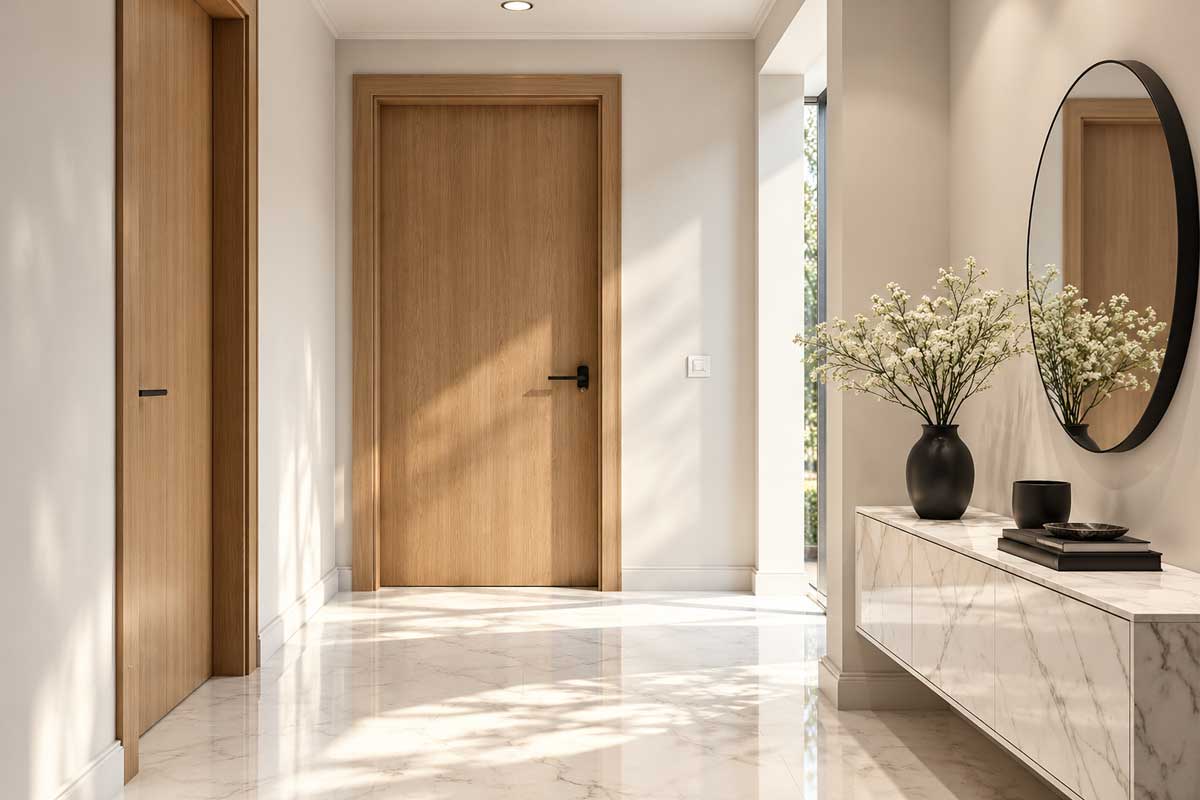
Hallways and entryways are among the spaces where lighting is often the last thing to be considered. Yet this is precisely where we need to see clearly when we come home, put on our shoes, or look for things in the closet. Poorly chosen lighting can create dark corners, unpleasant shadows, or make an already narrow space appear even smaller.
How do you choose lighting for your hallway and entryway that’s practical, inviting, and enhances the look of your interior? In this guide, we’ll look at suitable types of light fixtures, the necessary light intensity and color temperature, and the proper lighting for mirrors and storage areas. We’ll also advise you on how to choose lights for a small entryway or a long, narrow hallway and which mistakes are best to avoid.
Article Content
- What kind of lighting is suitable for hallways and entryways?
- How much light do hallways and entryways need?
- How to Choose Lights for a Narrow or Small Hallway
- How to Light a Mirror and a Wardrobe
- Which color temperature should you choose?
- Is lighting with a motion sensor worth it?
- Common Mistakes in Hallway Lighting
- Frequently Asked Questions
What kind of lighting is suitable for hallways and entryways?
When choosing lighting for a hallway or entryway, consider the size of the space, the ceiling height, and how the area is used. The key is to ensure there is enough light for safe movement and everyday activities, such as putting on shoes, getting dressed, or looking for items in a closet. In addition to the main ceiling light, spotlights, wall sconces, or freestanding lamps near a mirror can also be useful.
Each type lighting has a slightly different function. See when each solution is best suited and how to combine them, if applicable.
Ceiling lighting: a must-have for every hallway
light ceiling light should provide sufficient light throughout the entire space. For smaller entryways and hallways with low ceilings, surface-mounted models are usually the best choice, as they do not unnecessarily intrude on the space. A wider selection of shapes, sizes, and designs allows you to match light to both modern and classic interiors.
In a long hallway, light single light may not be enough. In such cases, it’s better to place several light sources along its length to avoid dark spots between them.

lighting: when you need to direct light more precisely
lighting are particularly well-suited for hallways with suspended ceilings or entryways where you want to illuminate specific areas of the space. For example, they can highlight the entrance, illuminate the area in front of a closet, or provide additional light near a mirror.
One of their advantages is the ability to distribute lighting across multiple points. However, proper placement is key—a few spotlights concentrated only near the door won’t provide enough light throughout the entire hallway. Our guide, “How to Properly Place Spotlights in a Room,” will help you with your planning.
Wall lighting: a cozier atmosphere and an interesting detail
Wall lighting are ideal as a complement to main lighting. In a long hallway, they can visually break up the space, while in an entryway, they help highlight a painting, a decorative piece, or the texture of the wall.
The resulting effect depends on how the light is emitted. Models that shine toward the wall create subtle light patterns, while lighting with direct light can better illuminate a specific area. If wall lights are also intended to serve as the main source of lighting, their output and light distribution must be evaluated more carefully.
How can you combine different types of light fixtures?
Not every hallway needs several different light sources. In a small entryway, light well-designed ceiling light can provide everything you need. In a larger or more complex space, on the other hand, it’s worth dividing the lighting according to specific activities.
| Part of the entryway | The Right Solution | Main Benefits |
|---|---|---|
| The entire space | Ceiling light | Basic orientation and uniform lighting |
| Long Hallway | More ceiling lights or spotlights | Reducing dark spots |
| Painting or decoration | Wall or directional light | Highlighting interior details |
| Mirror and wardrobe | Standalone functional lighting | Easier dressing and checking your appearance |
When planning, focus primarily on where you need good visibility and where you want to create a more pleasant atmosphere. The goal isn’t to use as many light fixtures as possible, but to choose a combination that suits the layout and actual needs of your home. For more inspiration, see the article “How to Combine Different Types of Lighting in Your Home.”
How much light do hallways and entryways need?
A hallway needs sufficient light for safe movement, easy navigation, and everyday activities such as putting on shoes or looking for items in a closet. The lighting doesn’t have to be as intense as over a kitchen countertop, but it should cover the entire space without any noticeably dark corners or unpleasant contrasts.
For a typical hallway or entryway, a lighting level of approximately 100–150 lx can serve as a general guideline. However, specific requirements vary depending on the size and layout of the space, the colors of the surfaces, and how the space is used. If you’re choosing clothes in the entryway, checking your appearance in the mirror, or need to see details clearly, it’s worth supplementing the main lighting with task lighting in these areas.
Lumens, lux, and watts: what should you look for when choosing?
On the packaging or in the technical specifications lighting, you’ll find several pieces of information that are easily confused. However, each one describes something different:
| Data | What does this mean? | Why are you interested? |
|---|---|---|
| Lumens (lm) | The total amount of light emitted by a light source. | They help assess lighting luminous flux. |
| Lux (lx) | The amount of light falling on a given area. | They show how well the floor or other work surface is lit. |
| Watts (W) | The electrical power consumption of lighting or light source. | They help assess energy consumption, not the amount of light itself. |
A higher lumen output does not automatically mean that a hallway will be evenly lit. It also depends on the direction of the light, ceiling height, the placement of the fixtures, and the reflectivity of the surfaces. A narrow beam angle can create a brightly lit spot, while the rest of the space remains darker.
For a more detailed explanation, see the articles “How Many Lumens Do Different Rooms Need?” and “Lumens vs. Watts: What’s the Difference and What to Look for in LED Lighting.”
How do the size and color of a hallway affect the final lighting?
The same light output can have a different effect in different interiors. Light-colored walls and ceilings reflect more light, so the space can appear brighter and more open. Dark surfaces, on the other hand, absorb more light, and the hallway may appear less well-lit.
The length of the room also plays an important role. In a long hallway, light single powerful ceiling light may not provide enough light along its entire length. You can often achieve better results with several strategically placed lights, which will minimize dark spots.
How can you tell if hallway lighting is well-designed?
When moving around normally, you should be able to see the floor, stairs, and objects in your path clearly. The light should be distributed evenly and should not dazzle you when you look up at the ceiling or into a mirror. If you have dark corners in your entryway, try adjusting the placement of your light fixtures first before automatically opting for a more powerful model.
How to Choose Lights for a Narrow or Small Hallway
A small entryway or a long, narrow hallway presents a specific challenge when designing lighting. Lighting must not obstruct movement, and the light should visually open up the space rather than emphasize its cramped proportions. Therefore, not only the design of the fixtures but also their size, placement, and the way they emit light play an important role.

For low ceilings, choose surface-mounted lighting
In smaller entryways with low ceilings, surface-mounted ceiling lighting or low-profile ceiling panels usually work well. They don’t take up much space and don’t get in the way of daily activities. If you have a suspended ceiling, you might also consider recessed lighting, which are unobtrusive and allow you to distribute light to multiple areas.
When making your selection, avoid overly large light fixtures, which could make a small entryway feel cluttered. A simple shape and moderate dimensions will generally help maintain an airy look in the interior.
Space the lights evenly along a long hallway
In a long hallway, it is important that the light covers the entire space, not just the center or the entrance area. Depending on the layout, you can use several ceiling fixtures spaced at regular intervals or a row of spotlights. The specific distance between them depends on the light output, beam angle, ceiling height, and desired lighting intensity.
If you want to create a more striking architectural effect, you might also consider indirect lighting, such as using a light profile along the ceiling. Light reflected from the ceiling appears softer and can help soften sharp contrasts between different sections of the hallway.
Light-colored surfaces and indirect lighting help make a space feel more airy
Light-colored walls and ceilings reflect more light than dark surfaces. In a small entryway, they can help create a more open feel. Indirect lighting works in a similar way; it doesn’t shine directly into your eyes but is reflected off the wall or ceiling.
This doesn’t mean you have to use only white lighting or cool light in a small hallway. What’s more important is the right combination of light output, lighting direction, and interior surfaces. If you want to better understand how lighting affects the perception of space, be sure to read the article “Lighting a Small Apartment: How to Visually Enlarge a Space.”
Avoid glare and stark light contrasts
In a narrow hallway, we often move close to walls and light fixtures, so it’s important to pay attention to glare reduction as well. A light source that’s too intense in your direct line of sight can be uncomfortable, especially when looking up or when coming from a darker room.
A good choice might be lighting with diffused light, a high-quality diffuser, or well-designed optics. The result should be even and comfortable lighting that makes it easier to find your way around while allowing the interior itself to shine.
How to Light a Mirror and a Wardrobe
In the entryway, you need light not only to find your way around, but also to check your appearance, choose your clothes, or look for items in the closet. The main ceiling light may not be sufficient for these activities, as the light often doesn’t reach where you need it. A practical solution is to supplement it with separate lighting for the mirror or closet.
How should you position a light near a mirror to avoid shadows?
The most important factor is the direction from which the light hits your face. If the light comes only from above, pronounced shadows may form under your eyes, on your nose, and on your chin. You can achieve more even lighting by placing a light fixture appropriately on either side of the mirror or above it.

Lighting on the sides
They help illuminate the face from both sides and reduce harsh shadows. They are particularly suitable for use where there is ample space around the mirror.
Light fixture above the mirror
A practical option for narrower entryways. Choose a model with a wide enough beam to illuminate your entire face, not just the upper part.
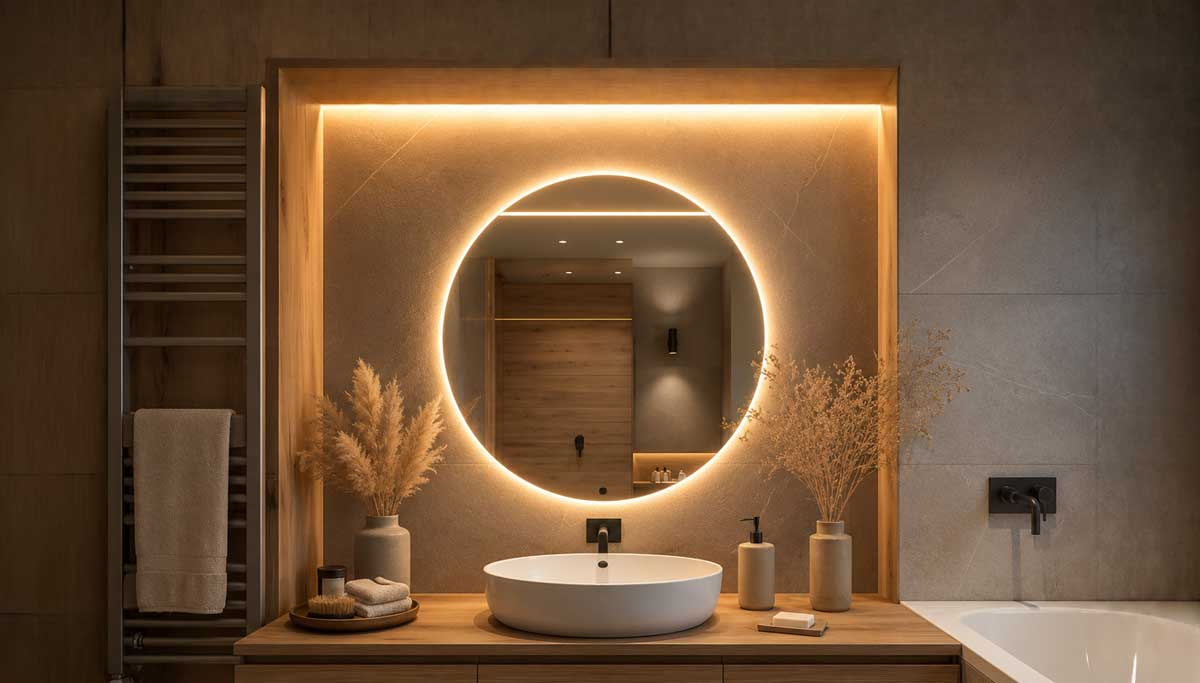
Lighted mirror
A compact solution that combines a mirror and a light source. Before purchasing, make sure it has sufficient light output for everyday use.
Similar principles apply to bathroom mirrors as well. For more tips, see the article “How to Properly Light a Bathroom Mirror.”
Wardrobe Lighting: A Better View of Your Clothes
A built-in closet in the entryway can be quite deep, and its interior often remains in the shadows, especially if it has a dark finish. Dedicated lighting makes it easier to find clothes and small items and makes using the storage space more enjoyable every day.
- LED lighting inside the closet—illuminates shelves, drawers, or the area with hanging clothes.
- LED profiles and strips—they can be installed, for example, under shelves or along interior side walls.
- Under-cabinet lighting—a good alternative if you don't want to install lighting directly into the furniture.
If you’re still in the planning stages for your cabinet, it’s worth considering the power supply and placement of light sources before the furniture is built. For retrofitting, battery-powered or rechargeable LED lights may be more practical, or models with a sensor that activates the lighting when the door is opened.
The quality of light matters just as much as its placement
Natural color rendering is also important for mirrors. If you want to accurately perceive your skin tone or the color of your clothing, choose a light source with a Color Rendering Index (CRI) of at least 90. A higher CRI value means more accurate color rendering. When selecting lighting for a mirror, we therefore recommend a CRI of at least 90, which will allow you to better see the true shades of your face and clothing.
At the same time, the light should not cause unpleasant glare or create sharp reflections in the mirror. Therefore, a sufficiently diffused light output and a color temperature that matches the rest of the entryway are recommended.
You can learn more about color rendering quality in the article “What Is CRI and How Does It Affect the Appearance of Colors in Interiors?”
What should you keep in mind?
For a comfortable entryway experience, combine general lighting with task lighting near the mirror or inside the closet. For the mirror, prioritize even facial lighting and accurate color rendering; for the closet, ensure that the light reaches even the hard-to-reach areas.
What color temperature should you choose for your hallway and entryway?
Light temperature significantly affects the feel of a hallway or entryway. While warmer tones create a cozy atmosphere, neutral white light feels fresher and helps you perceive colors more accurately. When making your selection, therefore, it’s not just the appearance of lighting itself that matters, but also the atmosphere you want to create at home and how the lighting complements the other rooms.
Color temperature is measured in kelvins (K). The lower the value, the warmer and more yellowish the light typically appears. Higher values, on the other hand, correspond to whiter to bluish hues.

How do the different light temperatures differ?
| Color temperature | How it works | Recommended uses |
|---|---|---|
| 2700 K | Warm, cozy | Entrance halls designed to create a cozy, homey atmosphere; interiors featuring warm materials |
| 3000 K | Warm white, pleasant | Most standard home hallways and entryways |
| 4000 K | Neutral white, fresh | Modern interiors, spaces with an emphasis on a clean and minimalist look |
| 5,000 K and higher | Cooler, bright white | It is rarely used in typical home entryways |
What color temperature do we recommend?
For most home hallways and entryways, this is a good choice 3000 K. It provides a pleasant, warm white light that isn’t too yellow and blends well with residential interiors. If your home features mostly warm wood tones, beige shades, or natural materials, this option may be particularly suitable.
4000 K It may be better suited to modern interiors with white, gray, or distinctly minimalist elements. However, it’s important to coordinate the lighting with the surrounding rooms, especially if the hallway opens directly into the living room or kitchen.
Tip for a Coordinated Interior
If the hallway connects to the living room, consider using a similar color temperature in both spaces. A stark contrast between warm and cool light can be distracting when looking from one room to the other. However, you don’t have to use the exact same color temperature everywhere—the important thing is that the different parts of the interior flow naturally into one another.
If you want to understand color temperature in more detail and choose the right one for other rooms as well, read our article “What Is CCT and How to Choose the Right Color Temperature.”
Is lighting with a motion sensor worth it?
In hallways and entryways, we often need light for only a short time—when coming home, heading to another room, or making a nighttime trip to the bathroom. A motion sensor automatically turns the light on when it detects movement and turns it off again after a certain amount of time. This way, you don’t have to search for the light switch, and the light doesn’t stay on unnecessarily when no one is using the space.
Where does a motion sensor make the most sense?
Automatic lighting is particularly suitable for areas where you spend short periods of time on a regular basis. You can use it, for example:
- At the front door—the light turns on when you come home, even if your hands are full of groceries.
- In a long hallway—you don’t have to look for the light switch or walk back to the door to turn off the lights.
- On your way to the bathroom at night—softer lighting makes it easier to find your way without having to turn on all the lights in the apartment.
- In the closet or utility room—the light turns on only when you’re actually using the space.
How does the sensor work, and what settings are available?
Most standard motion sensors use infrared detection or another method of motion sensing. As soon as they detect motion within their range, they activate the lighting. If they do not detect any further motion for a set period of time, the light automatically turns off.
Depending on the type of system, sensors can be part of lighting, a separate component of the electrical installation, or part of a smart home system. Some models also allow you to adjust the sensitivity to ambient light, so that the lighting turns on only when it is actually needed in the room.
- Sensor range: It should detect movement as soon as someone enters the hallway so that the light turns on in time.
- Lighting Duration: Choose a sensor that allows you to set how long the light stays on after motion is detected.
- Daylight sensitivity: Thanks to this feature, the light does not have to turn on automatically when there is sufficient natural light in the hallway.
- Manual control: It’s convenient to be able to turn the light on using a standard light switch or to leave it on longer—for example, while cleaning.
Don't forget about comfort at night
If you also use the hallway at night, it may not be pleasant when the sensor turns on the main lights at full brightness every time. If your system allows it, set a lower brightness level or use a separate ambient light. Soft lighting that doesn’t unnecessarily dazzle you is often enough to move safely around your home.
Tips for Choosing
Before purchasing, check whether the sensor is included with lighting or must be installed separately. If purchasing a separate sensor, also check its compatibility with the LED light fixture and the control method, especially if you use dimming or a smart home system.
Motion sensor or a standard light switch?
For a hallway where you only need light for a few minutes, a motion sensor is often very practical. In an entryway, where you regularly change clothes, put on shoes, or look for things in the closet, a manual switch may be more useful, because the automatic shut-off may not always match how long you stay in the space.
In many homes, a combination of both options works best. Automatic activation ensures convenience when passing through a room, while manual control provides greater flexibility in situations where you need the light on for a longer period of time.
Common Mistakes When Lighting Hallways and Entryways
Even light high-quality light can perform poorly in an interior if it doesn’t match the size of the space or how it’s used. When planning hallway lighting, it’s therefore worth considering not only the design, but also the evenness of the light, comfort during everyday use, and the proper placement of the fixtures.
One light for the entire long hallway
A single central light may not illuminate a long or winding hallway evenly. The area directly beneath the light fixture may be sufficiently bright, while more distant sections remain dark.
How to fix it: For longer hallways, consider placing multiple light fixtures along the length of the space. Adjust their number and spacing based on the light output, beam angle, and ceiling height.
Light that is too dim or uncomfortably bright
Insufficient lighting makes it harder to find your way around, while light that is too intense can be blinding, especially at night. Furthermore, a high lumen output alone does not guarantee that the light will be distributed properly throughout the space.
How to fix it: Take into account the dimensions of the hallway, the color of the surfaces, and lighting lighting design. If you want to adjust the light intensity for different situations, consider a dimmable solution that’s compatible with both the light fixture and the control system.
Inappropriately selected color temperature
Light that is too cold can look out of place in a cozy, well-furnished entryway. A significant difference between the lighting in the hallway and the adjacent rooms can also be distracting.
How to fix it: For most home hallways, a color temperature around 3000 K is a good starting point. Tailor your final choice to the materials, interior colors, and lighting in adjacent rooms.
Shadows on the face in front of the mirror
If a mirror is lit only by ceiling light, pronounced shadows can form on your face. This is impractical when touching up your appearance or checking your outfit before leaving the house.
How to fix it: Add a separate light fixture above or on either side of the mirror. The light should illuminate the face evenly and should not cause an unpleasant glare.
Select by appearance only
lighting design is important, but it shouldn’t be the only criterion. A model that’s too large can get in the way in a low-ceilinged entryway, and light with an inappropriate light distribution may not adequately illuminate the entire space.
How to fix it: In addition to appearance, also consider the dimensions, luminous flux, beam pattern, and maintenance requirements. For fixtures with an integrated LED module, also check the information on lifespan and any available service options.
What to Check Before Buying Lighting
Before you choose specific lighting, check these four things:
- Dimensions: Measure the length and width of the hallway as well as the ceiling height so you can choose the right size and placement for the light fixtures.
- Light output: Compare the luminous flux of the fixtures and consider whether you will need one or more light sources.
- Controls: Decide whether a standard light switch is enough for you, or if you’d prefer to use a motion sensor or dimming.
- Power Supply and Installation: Make sure light you choose is compatible with your hallway’s electrical wiring and installation method.
Frequently Asked Questions
What kind of lighting is best for hallways and entryways?
Ceiling lighting are suitable for most hallways and entryways, providing basic lighting for the entire space. In longer hallways, it’s a good idea to supplement them with several light sources spaced at regular intervals. In an entryway with a mirror or built-in closet, it may also be practical to have separate lighting for these areas.
How many lumens do I need for my hallway?
The required luminous flux depends on the size of the hallway, the ceiling height, the color of the surfaces, and the placement of the light fixtures. It is important not only to consider the total number of lumens, but also how evenly the light is distributed throughout the space. Therefore, when making your selection, take into account both the recommended illuminance and the specifications lighting specific lighting.
What color temperature is best for a entryway?
For a typical home entryway, a warm white light color of around 3000 K is often a good choice. In modern interiors, a neutral white of around 4000 K can also work well. Tailor your selection to the colors and materials in the interior, as well as the lighting in adjacent rooms.
How do you light a narrow, long hallway?
In a long hallway, it is important to distribute light evenly along its entire length. A good option might be several ceiling lights spaced at regular intervals, spotlights, or a combination of general and indirect lighting. When selecting Lighting also consider the ceiling height and glare control.
Are spotlights suitable for a hallway?
Yes, spotlights are particularly well-suited for hallways with suspended ceilings, where they allow for discreet installation and flexible placement. It is important to choose the appropriate beam angle, light output, and spacing to prevent dark spots from forming between individual lights.
Is it worth installing a motion sensor in the hallway?
A motion sensor is particularly useful in high-traffic areas where you only need the light on for a short time. The light turns on automatically when motion is detected and turns off after a preset interval. When choosing a sensor, focus on the sensor’s range, detection angle, and the ability to adjust sensitivity to ambient light.
How do you properly light a mirror in the entryway?
It’s best to position the light so that it evenly illuminates the face and doesn’t cast harsh shadows. lighting placed on either side of the mirror or light high-quality light above it are ideal. If you want natural color rendering for your face and clothing, choose light sources with a Color Rendering Index (CRI) of at least 90.
Is warm or cool light better for a hallway?
Most home hallways work well with warm white light around 3000 K, which creates a pleasant atmosphere and blends naturally with the living areas. Neutral white light around 4000 K may be suitable for modern interiors or spaces where you prefer a fresher look. Very cool light is rarely used in typical home entryways.
Choose the right lighting for your hallway and entryway
Well-designed lighting makes your daily life easier and helps create a pleasant first impression as soon as you enter your house or apartment. Browse our selection of designer lighting fixtures and find a solution that suits both the size of your space and your interior style.
Browse interior lighting
Share:
VK Leading Light: Greek lighting where design takes center stage