

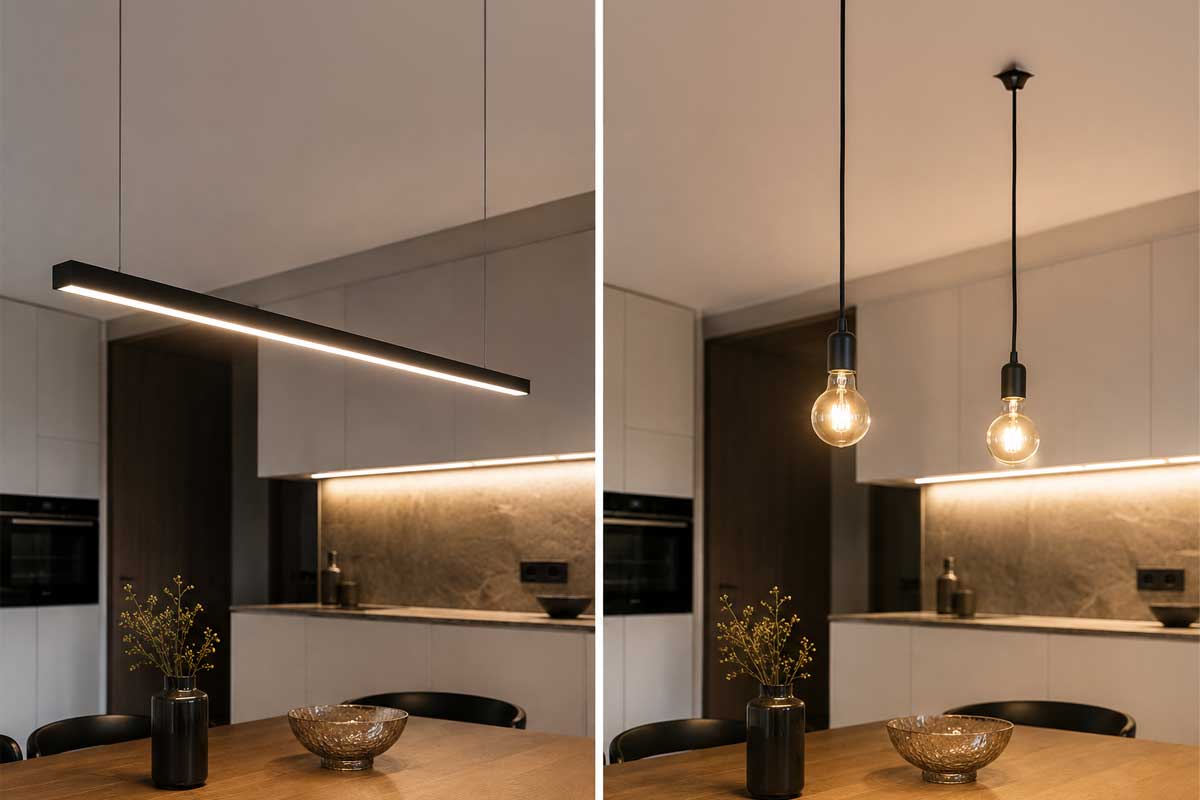
When choosing lighting new lighting today, you’ll encounter two main options—lighting with an integrated LED module and lighting with a replaceable bulb. Each solution has its advantages, disadvantages, and typical uses. Nevertheless, there are still many myths surrounding integrated LED modules. For example, many people worry that if a failure occurs, light entire light will need to be replaced, or that such a solution will last less than a traditional LED bulb.
In reality, no single option is universally better. It depends on where light will be used, as well as your requirements regarding design, lighting characteristics, lifespan, service, and the ability to replace the light source in the future. Each technology has its strengths and is suited for different applications.
In this article, we’ll objectively compare both solutions. We’ll explain their differences, advantages, and disadvantages; look at their lifespan and repair options; and offer advice on how to choose light that best suits your needs.
Article Content
- What is the difference between an integrated LED module and a replaceable light bulb?
- Integrated LED Module vs. Replaceable Bulb – A Clear Comparison
- Lifespan, Service, and Repairs
- How to Recognize light High-Quality light Regardless of the Type of Light Source
- When should you choose an integrated LED module, and when should you choose a replaceable bulb?
- The Most Common Myths About Integrated LED Modules
- Frequently Asked Questions

What is the difference between an integrated LED module and a replaceable light bulb?
Although both solutions use LED technology, their design and method of use differ significantly. While the integrated LED module is a fixed part lighting lighting and is designed specifically for a particular model, the replaceable LED bulb is a separate light source that can be easily replaced with another at any time.
It is precisely this difference that affects not only the design lighting, but also maintenance options, future replacement of the light source, lifespan, and overall usability. Neither option is universally better—each was designed for slightly different requirements and situations.
| Integrated LED module | Replaceable light bulb |
|---|---|
| The LED module is an integral part lighting lighting and is designed specifically for that particular model. | The light fixture uses a standard socket (e.g., E27, E14, GU10, G9, or GX53), into which a new bulb can be inserted at any time. |
| It allows you to create very slim, minimalist, and stylish lighting. | lighting design must allow for space for the bulb and its replacement. |
| Manufacturers can precisely optimize the optics, cooling, and light distribution. | The light's specifications depend primarily on the selected LED bulb. |
| The light source is not intended to be replaced by the user. | The bulb can be easily replaced with a new one in just a few minutes. |
| With high-quality manufacturers, it is usually possible to have the power supply driver or the LED module itself serviced or replaced. | Maintenance is usually very simple—in most cases, all you need to do is replace the LED bulb with a new one. |
| The price is typically included in the cost of lighting entire lighting and depends primarily on its construction, design, and the technologies used. | The price lighting the light fixture and the light bulb are listed separately. The light bulb can be easily replaced in the future without having to buy light new light. |
| It is most commonly used in modern design, linear, and architectural lighting fixtures. | It is most commonly used in situations where ease of maintenance and the ability to replace the light source are priorities. |
However, the type of light source alone is not the only factor that affects lighting quality. Equally important are, for example, the CRI (color rendering index), luminous flux in lumens, and color temperature (CCT), all of which have a significant impact on the overall comfort of use.
Although they differ in design, both solutions can provide high-quality, energy-efficient, and long-term reliable lighting. The quality of lighting lighting workmanship, the components used, and the manufacturer are often more important than the technology itself.
An integrated LED module does not mean that you have to throw away light entire light if it malfunctions, just as light with a replaceable bulb is not entirely maintenance-free. With high-quality manufacturers, it’s often possible to replace the power supply driver or the LED module itself, whereas in fixtures with a socket, the socket itself may wear out over the years. Repairability always depends primarily on the quality of the specific manufacturer.
Integrated LED module vs. replaceable bulb
Neither of these options is generally better than the other. Each was designed for a slightly different use case, and each offers different advantages. It mainly depends on whether you prefer modern design and maximum light output, or the ability to easily replace the light source at any time.
Integrated LED module
- ✔️ Looking for modern designer lighting
- ✔️ Do you want the most even light possible?
- ✔️ Are you looking for a long-term solution without having to replace light bulbs?
- ✔️ Looking for DALI, Casambi, CCT, or other advanced features?
- ✔️ Do you prefer high luminous efficacy?
Once a standard light bulb reaches the end of its service life, it cannot simply be replaced. However, with high-quality manufacturers, it is often possible to service the LED module or power driver.
Replaceable LED bulb
- ✔️ Do you want the option to replace the light source at any time?
- ✔️ Do you like to adjust the color temperature or brightness?
- ✔️ Want to use smart LED bulbs?
- ✔️ Do you prefer easy maintenance?
- ✔️ Want more freedom when choosing a light bulb?
The final characteristics lighting depend on the bulb used. Cheaper LED bulbs may have poorer color rendering, lower light output, or a shorter lifespan.
If you’re choosing high-quality designer lighting for a new interior, an integrated LED module often makes more sense. However, if you want the option to replace the light source yourself at any time or adjust its settings, light with a replaceable bulb will be more practical. Neither solution is universally better—it depends on how you plan to use it and your personal preferences.

Lifespan, Service, and Repairs
Questions about lifespan and future repairs are among the most common reasons why people hesitate between an integrated LED module and a light fixture with a replaceable bulb. In reality, however, the type of light source itself is not the deciding factor. The quality of lighting construction, the electronics used, the availability of replacement parts, and the manufacturer’s service support have a much greater impact.

How long will it last?
Integrated LED modules in high-quality lighting fixtures typically have a lifespan of approximately 30,000 to 70,000 hours, and professional models often last even longer.
Depending on the manufacturer's quality, LED bulbs typically have a lifespan of around 15,000 to 30,000 hours. Once they reach the end of their lifespan, you can simply replace them with new ones.
What breaks most often?
In most cases, the LED technology itself isn’t the problem. For integrated fixtures, the most common issue is the power driver, which can often be replaced separately by reputable manufacturers. For fixtures with replaceable bulbs, it’s usually just the bulb itself that wears out.
Can light repaired?
Yes. Reputable manufacturers often offer replacement drivers, LED modules, and other service parts for many years after lighting is introduced to the market. For fixtures with a socket, replacing the light source is very simple, but after many years of use, it may be necessary to replace the socket itself, for example.
What should you look for when choosing?
When making a purchase, we recommend paying particular attention to the length of the warranty, the manufacturer’s reputation, the availability of replacement parts, and after-sales support. These factors have a greater impact on long-term satisfaction than the type of light source itself.
In addition to lifespan, we recommend paying attention to the lighting technical specifications. For example, high-quality power supply electronics, a high CRI, or a low UGR value often have a greater impact on overall comfort than the type of light source itself.
An integrated LED module does not automatically mean that you have to throw away light entire light if it malfunctions. Similarly, even light with a replaceable bulb is not entirely maintenance-free. Repairability always depends primarily on the manufacturer’s quality and the design of the specific model.
How to Recognize light High-Quality light Regardless of the Type of Light Source
When choosing lighting, people often focus solely on whether light uses a built-in LED module or a replaceable bulb. In reality, however, this parameter alone does not indicate the quality of the product. Much more important are the components used, the lighting characteristics, the cooling method, and the manufacturer’s customer support.

light well-designed light with an integrated LED module, as well as light high-quality light with a replaceable bulb, can easily last for many years. Conversely, cheaply manufactured products may have a shorter lifespan regardless of the technology used.
Lighting Characteristics
Pay particular attention to the light output (lumens), CRI value, correct color temperature (CCT), and low UGR value. These parameters have a greater impact on the final quality of lighting than the type of light source itself.
High-quality electronics
An important component of every LED lighting is the power driver. High-quality electronics ensure stable, flicker-free operation, a longer service life, and trouble-free dimming.
Warranty and Service
Reputable manufacturers typically provide longer warranties and offer replacement parts or service even several years after purchase. This is a good indicator of long-term quality.
A trusted manufacturer
Well-known brands invest in development, testing, and quality control. As a result, their lighting is generally more reliable and easier to maintain over the long term than the cheapest alternatives.
When choosing lighting, don’t base your decision solely on whether it has a built-in LED module or a bulb socket. Focus primarily on the quality of the light, the components used, the length of the warranty, and the manufacturer’s customer service. These factors have the greatest impact on your long-term satisfaction.
When should you choose an integrated LED module, and when should you choose a replaceable bulb?
The right choice depends primarily on what you expect from lighting. Some people are looking for a clean design and compact size, while others want the option to replace the bulb at any time or use smart lighting. The following overview will help you quickly determine which solution is best suited for your situation.
- ✓ Looking for a modern, minimalist design?
- ✓ Do you prefer the thinnest possible lighting
- ✓ Do you require even light distribution?
- ✓ Are you looking for a high-quality, long-term solution?
- ✓ You can use DALI, Casambi, or other professional control systems
- ✓ Do you want to be able to change the light source yourself?
- ✓ Do you like to adjust the color temperature or brightness of your lights?
- ✓ Do you use smart LED bulbs?
- ✓ Easy maintenance
- ✓ Are you looking for maximum flexibility for the future?
Which solution is best suited for different situations?
In most cases, it is not the type of light source that matters most, but the quality lighting lighting itself. Pay particular attention to luminous flux, CRI, color temperature, the manufacturer’s warranty, and the availability of replacement parts or service.
The Most Common Myths About Integrated LED Modules
There is a lot of inaccurate information circulating about integrated LED modules. Some of it originated back when the first LED lights were introduced, while other claims continue to be repeated online or in discussions. In reality, however, it depends primarily on the quality lighting lighting specific lighting and the manufacturer, not just on whether it uses an integrated LED module or a replaceable bulb.
As soon as the LED module fails, I have to throw away light entire light.
With high-quality manufacturers, it is often possible to replace the power supply driver or LED module, or to arrange for service even several years after purchase. The possibility of repair depends primarily on the manufacturer and the lighting design.
Lighting with replaceable bulbs are always more practical.
They are more practical when you want to easily change the light source or its settings. However, with designer lighting fixtures, it is often the integrated LED module that offers better lighting performance.
Integrated LED modules have a short lifespan.
High-quality LED modules typically have a lifespan of tens of thousands of hours. With proper cooling, they can last significantly longer than standard LED bulbs.
An LED module means lower light quality.
In reality, it’s often the other way around. Manufacturers can precisely design the optics, light distribution, and cooling, thereby achieving higher efficiency and better lighting comfort.
If you’d like to learn more about LED lighting, we also recommend articles on CRI, CCT, UGR, and IP ratings, which will help you understand how to choose high-quality lighting.
The type of light source alone does not determine the quality lighting. The decisive factors are the design, the electronics used, the cooling system, and, above all, the manufacturer. Both light high-quality light with an integrated LED module and light high-quality light with a replaceable bulb can easily last for many years.
Conclusion
Neither integrated LED modules nor replaceable bulbs are universally better solutions. Each technology has its advantages and is suitable for different applications. While integrated LED modules allow for the creation of modern, minimalist lighting with high luminous efficiency and precisely engineered optics, lighting with replaceable bulbs offer greater flexibility and the ability to easily replace the light source.
When making a selection, it is therefore not advisable to base your decision solely on the type of light source. More important are the overall quality lighting, the components used, the lighting characteristics, the availability of service, and the manufacturer’s reputation. It is precisely these factors that have the greatest impact on the lifespan, reliability, and long-term satisfaction with the lighting.
When choosing light new light, focus primarily on where it will be used and what your requirements are in terms of design, lighting comfort, maintenance, and future options for replacing the light source. light properly selected light will serve you reliably for many years, regardless of whether it uses an integrated LED module or a classic replaceable LED bulb.
Frequently Asked Questions (FAQ)
Is an integrated LED module better, or a replaceable bulb?
Neither option is universally better. An integrated LED module allows for the creation of modern, high-efficiency designer lighting with a precisely engineered light distribution. A replaceable bulb, on the other hand, offers greater flexibility and the ability to easily replace the light source as needed.
What happens if the built-in LED module fails?
With high-quality manufacturers, it is usually not necessary to replace light entire light. Often, you can replace just the power supply driver or the LED module itself. The possibility of repair depends primarily on lighting lighting design and the availability of replacement parts.
Can the light source be replaced in an integrated LED module?
Unlike a traditional light bulb, the integrated LED module is not intended to be replaced by the user. However, for many high-quality light fixtures, a service provider or the manufacturer can replace the LED module or other components.
How long does the integrated LED module last?
High-quality integrated LED modules typically have a service life of approximately 30,000 to 70,000 hours of operation. The actual service life depends on the quality of the components used, the cooling system, and how lighting is used.
How long does an LED bulb last?
Modern, high-quality LED bulbs typically have a lifespan of around 15,000 to 30,000 hours. When they reach the end of their lifespan, simply replace the light source with a new one.
Is it worth buying light with a built-in LED module?
It depends on your needs. If you’re looking for a modern design, high luminous efficacy, or advanced lighting control options, an integrated LED module is often a very good choice. If, on the other hand, you prefer the ability to easily replace the light source at any time or use smart LED bulbs, light with a replaceable bulb may be more practical.
In which types of light fixtures are integrated LED modules most commonly used?
You’ll most often find it in modern ceiling, pendant, wall, or linear fixtures, where it enables a very slim profile, clean design, and precisely engineered lighting characteristics.
When is it better to choose light with a replaceable bulb?
If you want the option to change the light output or color temperature at any time, or to use smart LED bulbs, light with a standard socket—such as E27, GU10, or G9—is usually more practical.
Does the type of light source affect the quality of light?
Not exactly. The quality of light is primarily influenced by the CRI value, luminous flux, the lighting optics, and the quality of the components used. Both integrated LED modules and replaceable LED bulbs can provide very high-quality lighting.
What should you look for when choosing lighting new lighting?
In addition to the type of light source, we recommend considering luminous flux, color temperature, CRI, dimming capabilities, warranty length, service availability, and the manufacturer’s reputation. These factors have a greater impact on long-term satisfaction than the LED module or replaceable bulb itself.
Find light that will suit your needs for years to come
Our selection includes designer lighting with built-in LED modules as well as models designed for replaceable bulbs. Choose a solution that meets your requirements for design, functionality, and intended use.

Share:
How to Properly Design Kitchen Lighting: A Complete Guide to Choosing Lights
The most common mistakes in interior lighting (and how to avoid them)